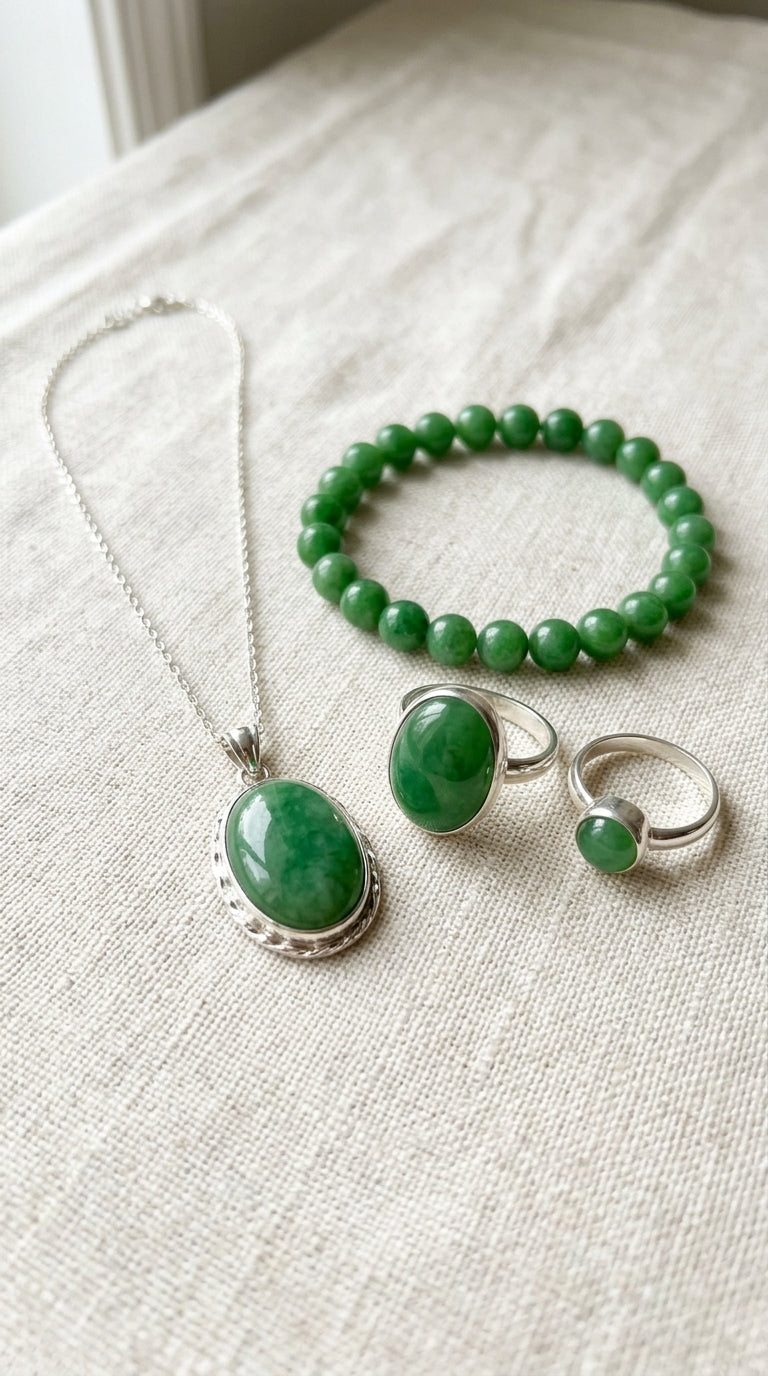
Jade jewelry carries millennia of history. No other stone has been as revered in Asia as jade: in China, for over 5,000 years, it has been considered the imperial stone, a symbol of wisdom, purity, and immortality. Emperors were buried in jade armor, scholars meditated with it between their fingers, and even today, a piece of jade jewelry is passed down from generation to generation in many Asian families. What is referred to as "jade" actually encompasses two distinct minerals: nephrite (more common, soft green, and opaque) and jadeite (rarer, more translucent, with more varied colors). Both are true jade.
In lithotherapy, jade is a stone of harmony, wisdom, and prosperity. It primarily works on the heart chakra and brings a gentle balance between body and mind. It is a stone that calms without sedating, that provides strength without being aggressive. It is recommended to promote sound decision-making, attract abundance, and cultivate inner serenity in daily life. Green jade is also known for its benefits for the kidneys and urinary system in Chinese tradition, hence its ancient name "kidney stone" (lapis nephriticus).
Jade pairs well with rose quartz (opening the heart), amethyst (spiritual appeasement), or citrine (abundance and optimism). For maintenance, rinsing with clear water and recharging in moonlight or soft sunlight once or twice a month is sufficient. Jade is a very resistant stone with a hardness of 6 to 7 on the Mohs scale and, above all, exceptional toughness, making it one of the hardest stones to break.