
Couldn't load pickup availability
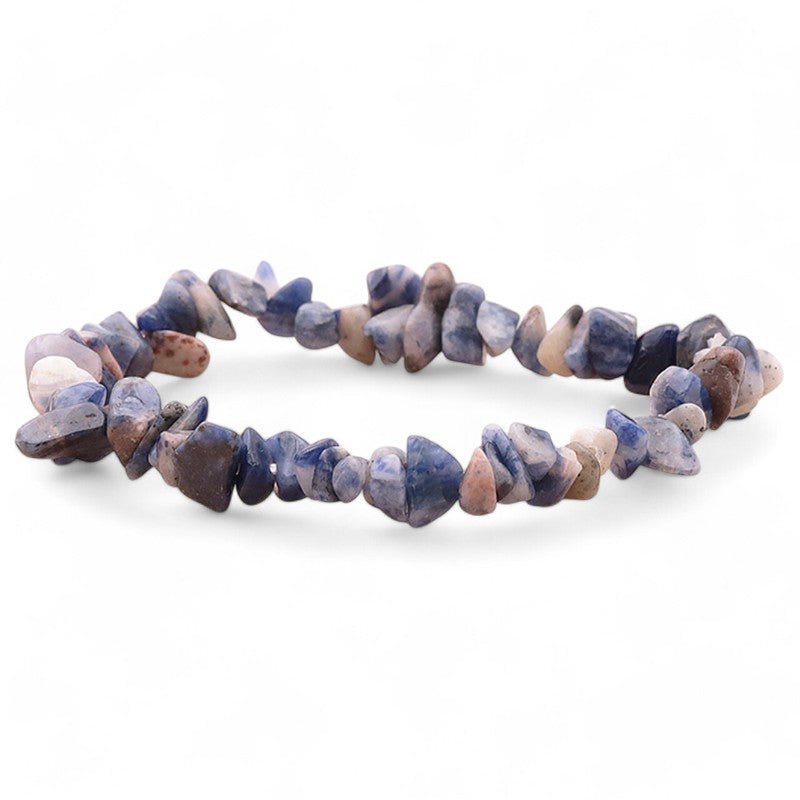
Beautiful Brazilian sodalite bracelet, made of polished baroque stones with beautiful shades of deep blue, royal blue, and grey-blue, naturally punctuated with white or cream areas.
Highly prized for its intense blue and contrasting patterns, sodalite offers a piece of jewelry that is both elegant and easy to wear. The natural variations of each stone make each bracelet unique.
This grade A Brazilian sodalite bracelet is made of natural polished baroque-shaped stones.
Sodalite is a mineral belonging to the feldspathoid group. It is mainly known for its superb blue color, which can vary from light blue to deep blue, sometimes accompanied by grey-blue nuances.
It frequently exhibits whitish veins, spots, or areas, particularly related to other minerals present in the rock. These natural patterns create beautiful contrasts and make it easy to distinguish each stone.
Baroque stones have irregular and uncalibrated shapes that enhance the natural and authentic appearance of the bracelet.
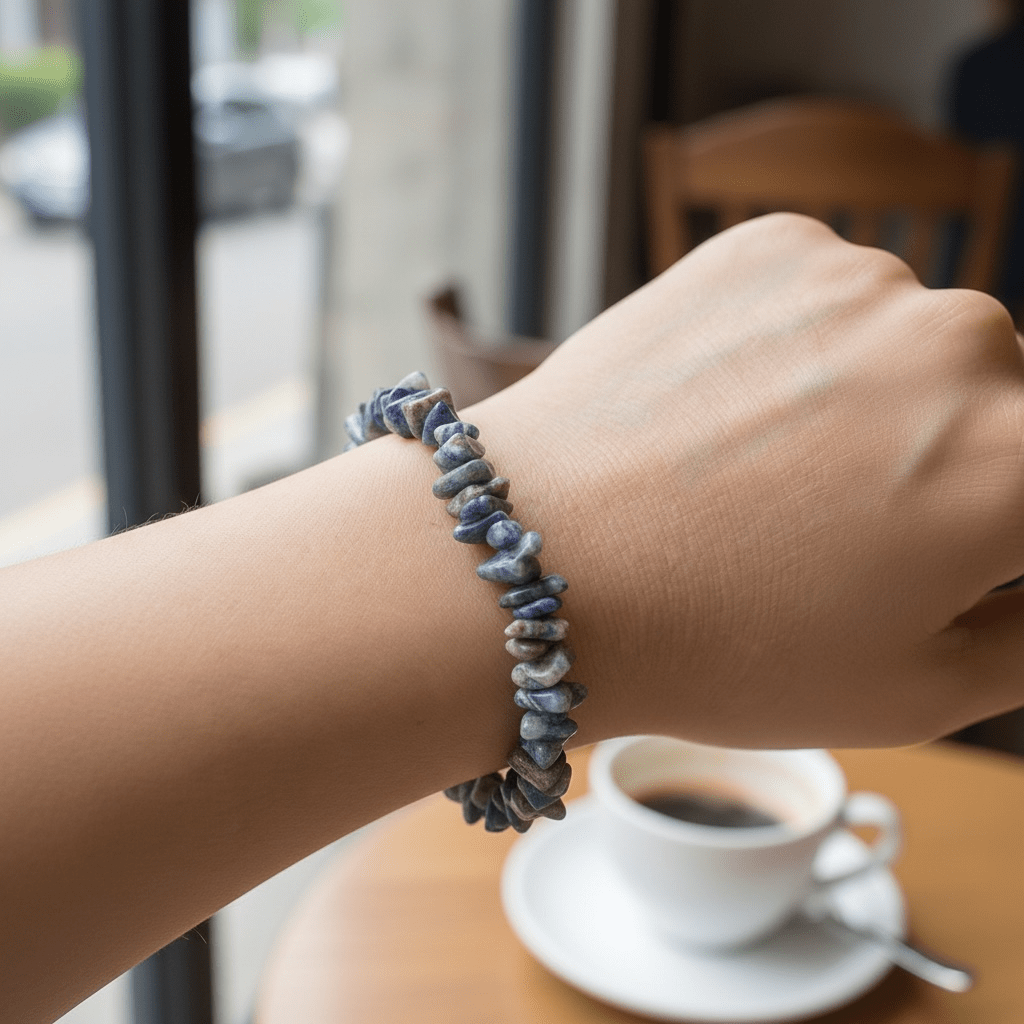
With a length of approximately 17 to 18 cm, this elastic bracelet is suitable for wrists measuring approximately 16 to 18 cm. Its very light weight of approximately 5 g allows it to be worn comfortably every day.
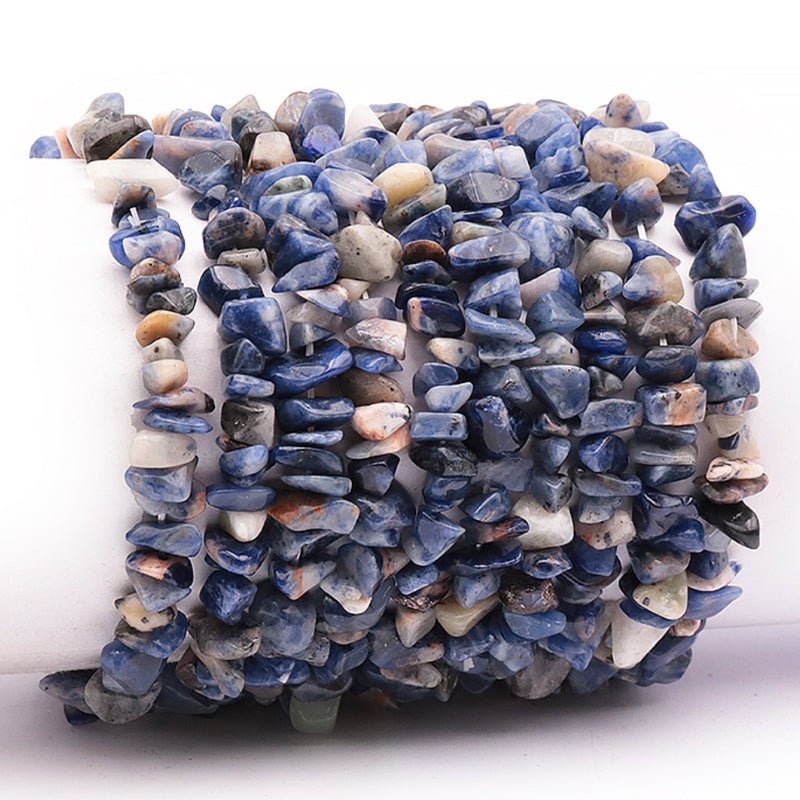
The shapes, patterns, inclusions, and shades of blue and white may vary from one stone to another and from one bracelet to another. Each item is unique.
Stone: Sodalite
Mineral family: Feldspathoids
Origin: Brazil
Grade: A – Good quality
Shape: Polished baroque stones
Dimensions: Approximately 17 to 18 cm
Recommended wrist size: 16 to 18 cm
Weight: Approximately 5 g
Assembly: Elastic bracelet
Colors: Blue, deep blue, grey-blue, white, cream
Special feature: Variable natural veins and patterns
In lithotherapy, sodalite is traditionally associated with calm, communication, and self-confidence.
It is said to be particularly appreciated for symbolically promoting a more calm and rational mind, especially during periods of stress or when emotions play a significant role.
Sodalite is also considered a stone of communication and personal expression. It is said to help express thoughts and feelings more clearly.
It is traditionally associated with concentration, logic, and reflection, making it a stone often chosen during periods of study or intellectual work.
On an emotional level, sodalite is also associated with self-esteem and confidence, symbolically encouraging better acceptance of one's personality and choices.
In lithotherapy, it is mainly linked to the throat chakra, associated with communication and expression, as well as the third eye chakra, traditionally linked to intuition and reflection.
The properties attributed to stones are derived from lithotherapy traditions and beliefs. They do not replace a diagnosis, treatment, or medical advice.
Sodalite is a mineral belonging to the feldspathoid group.
It owes its name to its relatively high sodium content.
Although blue is by far the best-known and most sought-after color in jewelry, sodalite can exhibit different shades and be associated with other minerals.
Massive specimens are widely used for making jewelry, beads, tumbled stones, sculptures, and decorative objects.
The blue color of sodalite is linked to its crystalline structure, particularly the presence of color centers containing sulfur.
Depending on the stone, the color can range from a relatively light blue to a particularly intense royal blue or midnight blue.
The distribution of color is not necessarily homogeneous, which explains the different shades visible on the beads.
Sodalite used in jewelry is frequently found associated with other minerals.
The white areas and veins visible in some stones may correspond to calcite or other constituents of the rock.
The proportion of blue and white can vary greatly from one stone to another.
Some sodalites are almost entirely blue, while others have a much more marbled appearance.
Brazil is an important source of many stones used in jewelry, including different varieties of quartz and numerous decorative minerals.
Brazilian sodalite can display beautiful blue tones associated with lighter areas.
Once polished, the contrast between these different colors is particularly highlighted.
Sodalite and lapis lazuli are regularly confused due to their blue color.
However, there are several important differences.
Sodalite is a mineral, while lapis lazuli is a rock composed of several minerals, including lazurite.
Lapis lazuli may exhibit small golden metallic inclusions of pyrite, which are very characteristic.
Sodalite more frequently exhibits white or cream veins and generally does not have the characteristic golden appearance of pyrite-rich lapis.
Sodalite and lazurite belong to the same broader mineralogical family and can have relatively similar colors.
Lazurite is one of the main minerals responsible for the blue of lapis lazuli.
Sodalite, on the other hand, is used as a stone in its own right and generally has a blue accompanied by white or grayish areas.
Sodalite is sometimes used as an alternative to lapis lazuli due to its intense blue and generally more accessible price.
However, it has its own mineralogical identity and should not be presented as a variety of lapis lazuli.
Its white patterns and numerous variations of blue are precisely part of its aesthetic appeal.
Baroque stones have irregular shapes, unlike perfectly round and calibrated beads.
This finish allows for greater preservation of the natural character of sodalite.
Some stones can be almost entirely dark blue, while others will have more white, gray, or light blue.
Each bracelet therefore has its own combination of shapes, colors, and patterns and may differ significantly from the photographs shown.
Sodalite requires some precautions to maintain its appearance over time.
Avoid strong impacts, chemicals, perfumes, and household products.
Prolonged contact with water is also not recommended, especially to preserve the polish of the stones and the elastic thread.
For routine cleaning, use a slightly damp soft cloth, then carefully dry the stones.
Preferably remove your bracelet before showering, swimming, cleaning, or engaging in sports activities.
This jewelry highlights the unique reflections of sodalite. Find all our sodalite bracelets to complete your collection.
Color :
Astrological sign:
Stone Type:
Age :
Gender :
Sodalite bracelet Brazil A (baroque pearls)
Paypal, credit card, check, transfer
FREE DELIVERY
from 40€ purchase
SATISFIED OR REFUNDED
14 days to change your mind
CUSTOMER SERVICE AVAILABLE
contact@laboiteacailloux.com
to receive all our offers, good deals and new products from La Boite à Cailloux
Les vertus décrites relèvent de la tradition de la lithothérapie et ne constituent ni un avis médical ni un conseil de santé. En cas de problème de santé, consultez un professionnel.

