



Couldn't load pickup availability
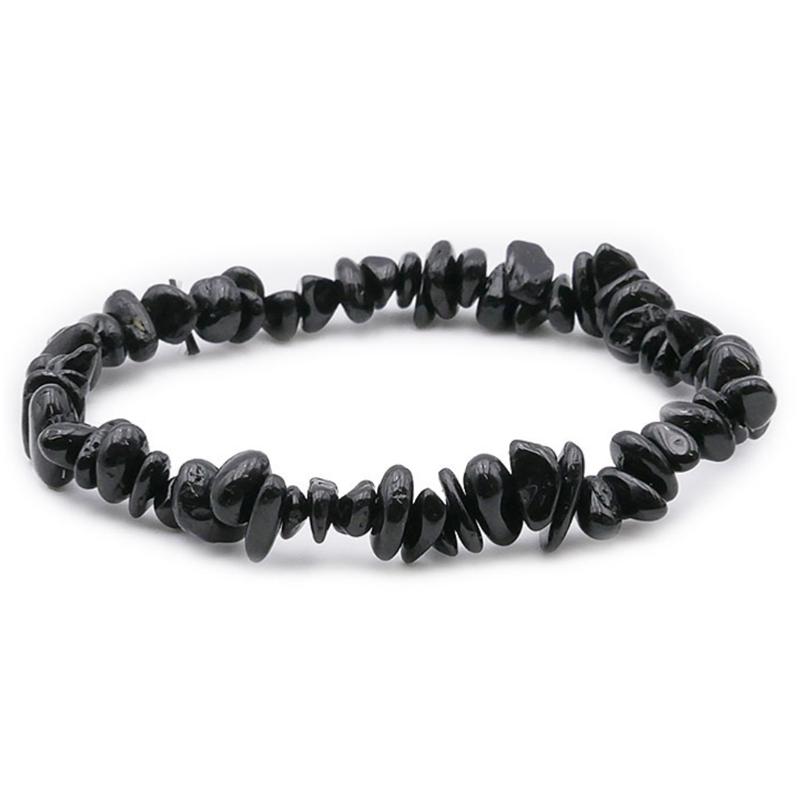
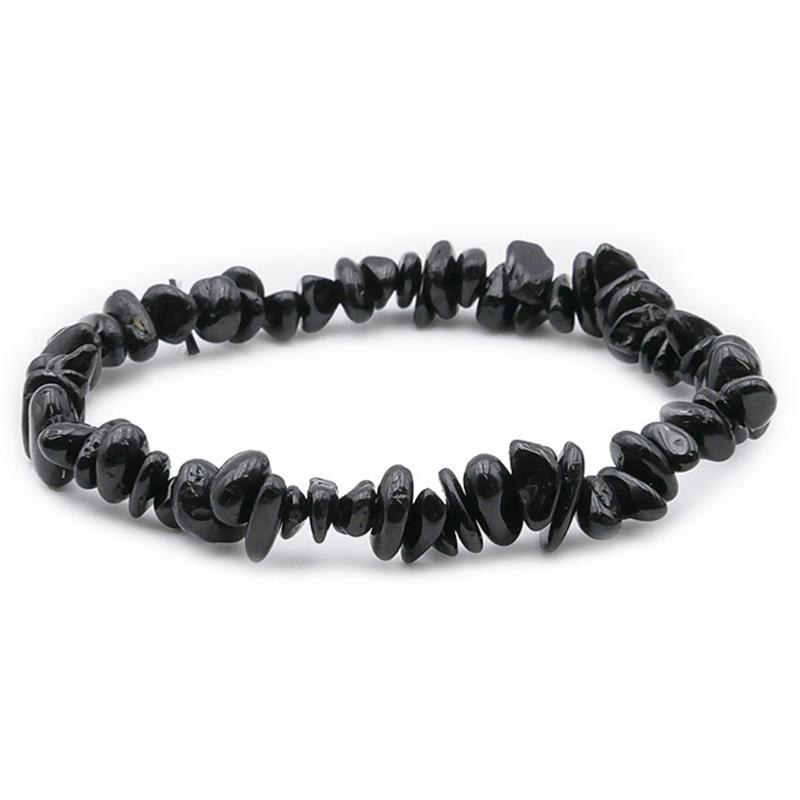
Beautiful Grade A black tourmaline bracelet from Brazil, composed of polished baroque stones with deep shades of black and charcoal black.
Appreciated for its sober and mineral appearance, black tourmaline is also one of the most popular stones in lithotherapy, where it is traditionally associated with protection and grounding.
The naturally irregular shapes of baroque stones give each bracelet an authentic and unique character.
This Grade A Brazilian black tourmaline bracelet – good quality is made of polished natural stones in a baroque shape.
Black tourmaline, commonly called schorl, is one of the most widespread species of the complex tourmaline group. It is characterized by its deep black color and, in its raw state, by often elongated crystals with characteristic longitudinal striations.
Its black color is mainly due to its richness in iron.
Once polished, black tourmaline can have an appearance ranging from matte black to glossy black, sometimes with slight irregularities, inclusions, or surface variations.
Baroque stones have naturally irregular shapes that allow for an aesthetic closer to the natural material than perfectly round and calibrated beads.
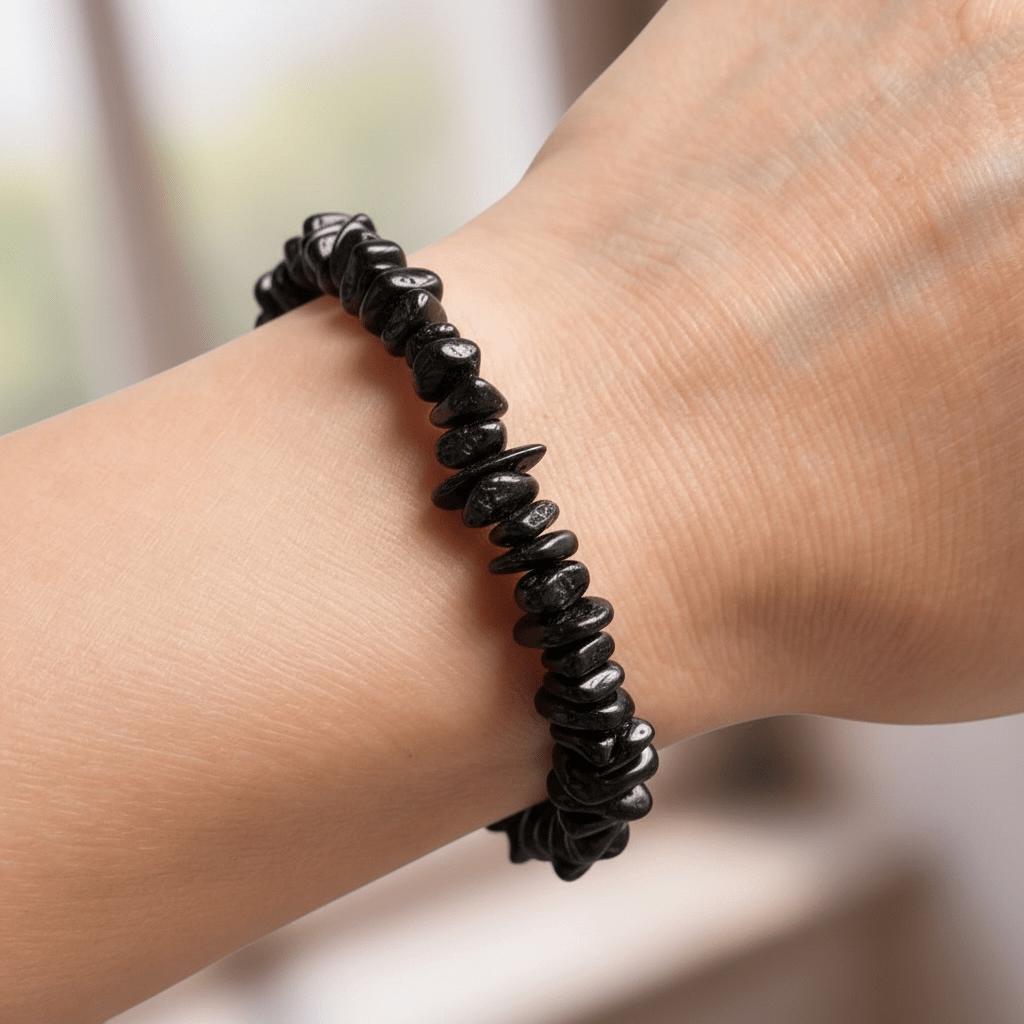
With a length of approximately 17 to 18 cm, this elastic bracelet is suitable for wrists measuring approximately 16 to 18 cm. Its weight of about 12 g gives it a pleasant presence on the wrist while remaining easy to wear daily.
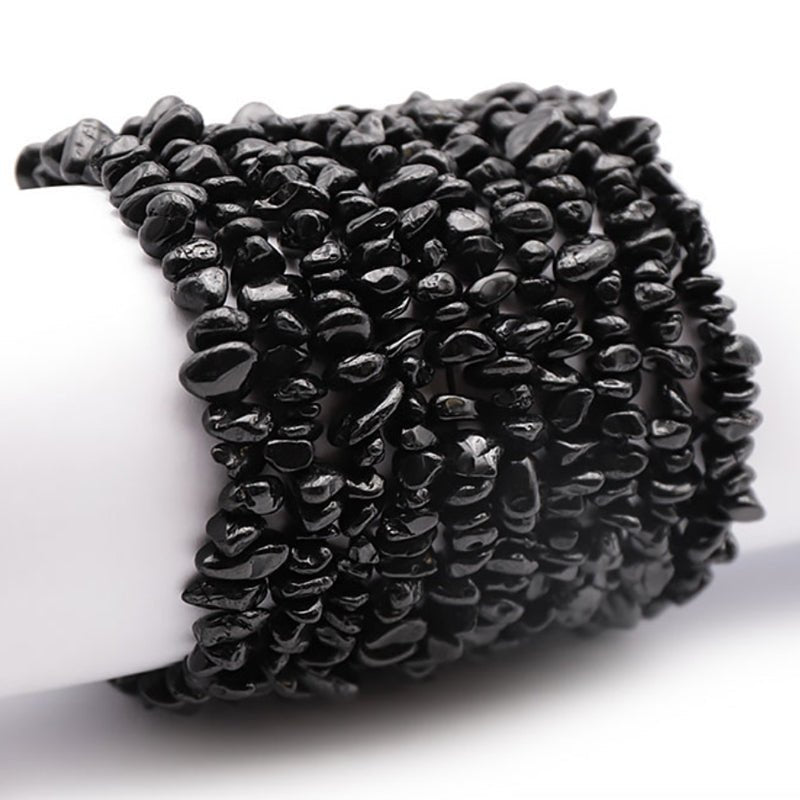
Shapes, dimensions, textures, and shades may vary from one stone to another and from one bracelet to another. Each item is unique.
Stone: Black Tourmaline
Mineral species: Schorl
Group: Tourmalines
Origin: Brazil
Grade: A – Good quality
Shape: Polished baroque stones
Dimensions: Approximately 17 to 18 cm
Recommended wrist size: 16 to 18 cm
Weight: Approximately 12 g
Mounting: Elastic bracelet
Colors: Black to charcoal black
Hardness: Approximately 7 to 7.5 on the Mohs scale
Special feature: Naturally iron-rich black stone
In lithotherapy, black tourmaline is traditionally considered one of the primary stones for protection and grounding.
It is particularly valued for symbolically helping to protect against negative energies and maintain better balance in environments perceived as stressful or charged.
Black tourmaline is also associated with grounding and stability. It is said to be used to symbolically promote a better connection to the present moment and help keep one's feet on the ground.
It traditionally accompanies periods of stress, change, or uncertainty, during which it symbolizes stability and recentering.
It is also frequently used in association with other stones, notably rock crystal, labradorite, or tiger's eye.
In lithotherapy, black tourmaline is mainly associated with the root chakra, traditionally linked to grounding, security, and stability.
The properties attributed to stones come from lithotherapy traditions and beliefs. They do not replace a diagnosis, treatment, or medical advice.
Tourmaline is not a single mineral but a group comprising several mineral species with complex chemical compositions.
The black variety commonly used in jewelry and lithotherapy generally corresponds to schorl, an iron-rich tourmaline.
Schorl is one of the most common tourmalines in nature.
It is found particularly in pegmatites and certain granitic or metamorphic rocks.
Its crystals can reach significant dimensions and frequently exhibit an elongated prismatic shape.
The very dark color of schorl is primarily linked to its high iron content.
This composition absorbs a large part of visible light, giving the mineral its characteristic black appearance.
Depending on the quality of the polish and the structure of the stone, its surface can appear matte, satin, or glossy.
Some stones may also reveal very slight brownish-black nuances when observed under particularly intense light.
Brazil is one of the most famous countries in the world for its tourmalines.
Its many pegmatites have produced an extraordinary variety of tourmaline crystals: black, green, pink, blue, or multicolored.
The state of Minas Gerais is particularly world-renowned for the richness and diversity of its gemstone deposits.
Brazilian black tourmaline is widely used in the manufacture of jewelry, bracelets, tumbled stones, pendants, and mineral objects.
In their raw state, tourmaline crystals are easily recognizable thanks to the longitudinal striations that frequently run along their faces.
These lines are directly related to the growth and crystalline structure of the mineral.
When a black tourmaline is transformed into a baroque stone and then polished, these structures are not necessarily visible, but some stones may retain irregularities reminiscent of their natural shape.
In the vast majority of cases, when we speak of black tourmaline, we are referring to schorl.
Schorl is a mineral species belonging to the tourmaline group and characterized in particular by its richness in iron and its very dark color.
"Black tourmaline" is therefore a common and easily understandable name for the public, while "schorl" corresponds to a more precise mineralogical identification.
For your Shopify product description, you can advantageously keep Black Tourmaline as the commercial name and mention Schorl in the characteristics and descriptive content.
Black tourmaline and onyx have a similar color once polished but are two completely different materials.
Black tourmaline belongs to the tourmaline group.
Onyx used in jewelry belongs to the chalcedony family, composed mainly of silica.
Polished onyx generally has a very homogeneous black surface, while tourmaline can retain more variations in texture and appearance.
Black obsidian is also regularly confused with black tourmaline.
However, obsidian is not a crystallized mineral: it is a natural volcanic glass resulting from the rapid cooling of lava.
Black tourmaline, on the contrary, is a crystallized mineral with a completely different structure and composition.
Polished obsidian often has a particularly vitreous appearance, while black tourmaline can show a slightly more mineral or irregular appearance.
Shungite is another very popular black stone in lithotherapy.
However, shungite is a natural carbon-rich rock, while black tourmaline is a crystallized mineral.
Their composition, formation, and physical properties are therefore very different despite a sometimes similar color.
In lithotherapy, the association of black tourmaline and labradorite is particularly popular.
Black tourmaline is traditionally associated with grounding and protection, while labradorite has symbolism related to emotional protection and intuition.
This combination is frequently chosen by people looking for a set of stones symbolically oriented towards protection and balance.
The association of black tourmaline and tiger's eye is also very common.
In lithotherapy traditions, tiger's eye is associated with confidence, courage, and protection, while black tourmaline is more linked to grounding.
These two stones are notably used in many so-called "triple protection" bracelets, sometimes complemented by obsidian or hematite.
Black tourmaline is frequently presented on lithotherapy sites as a stone that "protects against electromagnetic waves" emitted by phones, computers, Wi-Fi, or other electrical devices.
For a rigorous product description, however, I advise against presenting this claim as an established scientific fact.
You can indicate that it is traditionally used in lithotherapy as a protective stone, but it is preferable to avoid formulations stating that a black tourmaline bracelet neutralizes or blocks electromagnetic waves.
This distinction allows for a product description that is both commercially interesting and more credible.
Tourmaline nevertheless possesses genuinely interesting physical properties.
Some tourmalines are notably piezoelectric and pyroelectric: electrical charges can appear on their surface under the effect of pressure or temperature variation.
These phenomena are measurable physical properties of the mineral.
However, they do not mean that a tourmaline bracelet protects its wearer from electrical devices or electromagnetic waves.
This bracelet is offered in Grade A – good quality.
The stones may have slight differences in shape, brilliance, texture, or color.
Some will be perfectly black and shiny, while others may have a more matte surface or some natural irregularities.
These differences are particularly suited to the aesthetic of a bracelet composed of baroque stones.
Classifications A, A+, AA, or AAA do not correspond to a standardized international gemological scale. They primarily serve to distinguish several levels of selection offered by a supplier or seller.
Baroque stones have irregular shapes, unlike perfectly round and calibrated beads.
This finish allows for a greater retention of the natural and mineral character of black tourmaline.
Some stones may be rounder, others more elongated or angular.
Shapes, dimensions, textures, and shades may therefore vary from one bracelet to another. The received bracelet may naturally differ from the photographs presented.
With a hardness of approximately 7 to 7.5 on the Mohs scale, tourmaline has good resistance for use in jewelry.
However, it remains sensitive to significant shocks and sudden temperature changes.
Avoid contact with chemicals, perfumes, cosmetics, and household products.
For routine cleaning, simply use a soft, slightly damp cloth, then dry the stones carefully.
To also preserve the elastic thread, it is preferable to remove your bracelet before showering, swimming, cleaning, or engaging in sports activities.
This model is made from natural black tourmaline, selected for its quality. Explore our entire range of black tourmaline bracelets.
Color :
Astrological sign:
Stone Type:
Age :
Gender :



Les vertus décrites relèvent de la tradition de la lithothérapie et ne constituent ni un avis médical ni un conseil de santé. En cas de problème de santé, consultez un professionnel.