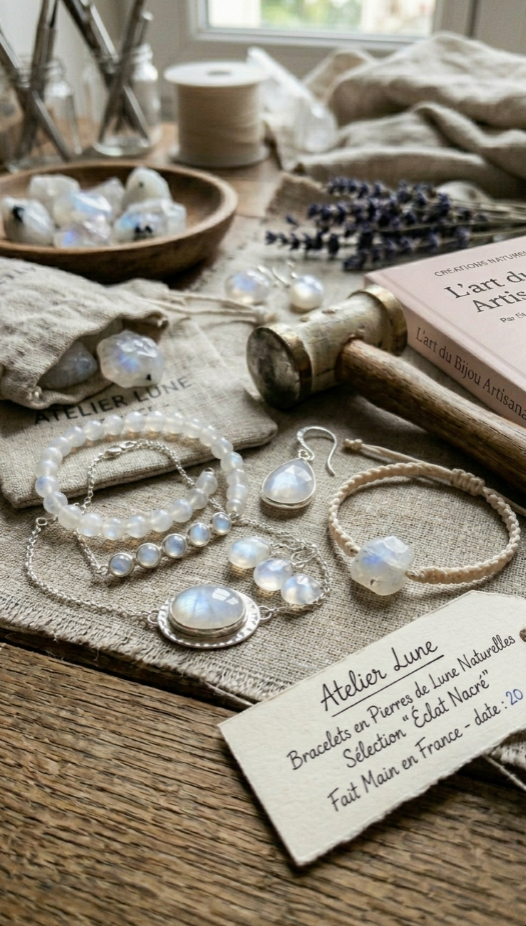
That milky veil gliding across the beads as you turn your wrist has a name: adularescence. Light scatters between the thin layers of feldspar that make up the stone, and each bead reacts a little differently depending on its transparency.
There are several moonstones. The white or bluish one, the most classic, comes mainly from India and Sri Lanka; peach, grey or chocolate shades are just as natural. "Rainbow moonstone", with its strong blue flashes, is in fact a white labradorite, also called peristerite: a very beautiful stone, but not the same one, which is why we say so in the name of our bracelets.
In crystal healing, moonstone is traditionally associated with intuition, cycles and gentleness. Many people wear it at times when they need to reconnect with their feelings. It is readily associated with femininity, but grey or chocolate beads look just as good on a man's wrist.
With a hardness of 6 to 6.5, it copes with everyday wear but dislikes sharp knocks, which can split it along its cleavage planes. Rinse it in clean water, let it dry, and take your bracelet off for the shower and sport: it is mostly the elastic that wears out.