
Couldn't load pickup availability
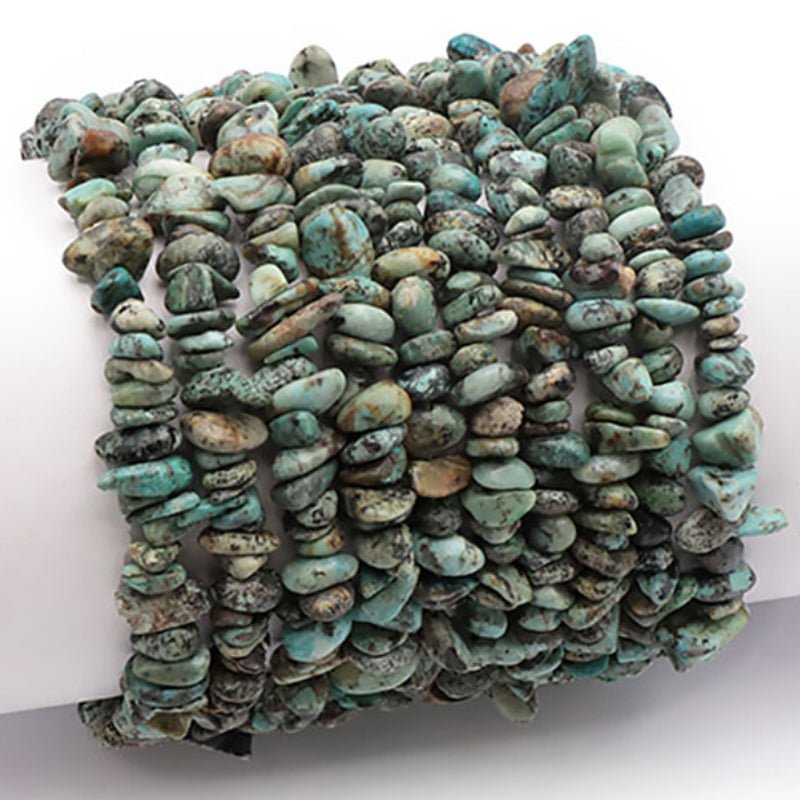
Beautiful A-grade African turquoise bracelet, made of polished baroque beads with natural shades of green, blue-green, turquoise, brown, and black, with unique patterns and veins.
The stone marketed as "African turquoise" is generally a jasper, and not true mineralogical turquoise. Its superb natural patterns and color variations give each bracelet a unique appearance.
This A-grade African turquoise bracelet – good quality – is made of polished baroque-shaped stones.
Despite its commercial name, African turquoise is generally not true turquoise in the mineralogical sense. The material sold under the names "African turquoise" or African Turquoise is most often described commercially as a variety of jasper, sometimes treated or colored to enhance its blue-green hues.
This stone is characterized by a remarkable diversity of colors that can combine green, turquoise green, blue-green, brown, beige, gray, and black.
Its numerous veins and inclusions create irregular patterns that sometimes resemble the matrix naturally present in some true turquoises.
The baroque beads reinforce the natural character of the bracelet with their irregular shapes and varying sizes.
With a length of approximately 17 to 18 cm, this elastic bracelet is suitable for wrists measuring approximately 16 to 18 cm. Its weight of about 10 g makes it comfortable for daily wear.
Shapes, patterns, veins, and color shades may vary significantly from one stone to another and from one bracelet to another. Each item is unique.
Commercial name: African Turquoise / African turquoise
Nature: Material generally marketed as a variety of jasper
Indicated origin: Africa
Grade: A – Good quality
Shape: Polished baroque beads
Dimensions: Approximately 17 to 18 cm
Recommended wrist size: 16 to 18 cm
Weight: Approximately 10 g
Mounting: Elastic bracelet
Colors: Green, blue-green, turquoise, brown, beige, gray, black
Special feature: Stone with naturally highly variable patterns and veins
In lithotherapy, African turquoise is traditionally associated with change, renewal, and personal evolution.
It is said to be valued for symbolically accompanying people going through a new stage in their lives or wishing to break free from their habits and open themselves to new possibilities.
It is also associated with self-confidence and optimism, symbolically encouraging one to approach changes with greater serenity.
African turquoise is also said to promote emotional balance, open-mindedness, and better self-understanding.
Due to its predominantly green to blue-green tones, it is traditionally associated with the heart chakra, linked to emotional balance and relationships, as well as the throat chakra, associated with communication and personal expression.
The properties attributed to stones come from the traditions and beliefs of lithotherapy. They do not replace a diagnosis, treatment, or medical advice.
The term "African turquoise" is primarily a commercial name.
Despite its name and appearance, this stone generally does not correspond to turquoise as defined in mineralogy.
It is most often marketed as a jasper with green to blue-green colors and characteristic dark patterns.
Its particularly decorative appearance explains its significant use in the manufacture of bracelets, necklaces, pendants, and beads.
No, not in the usual commercial use of this name.
True turquoise is a hydrated phosphate of copper and aluminum with a well-defined mineralogical composition.
The stone sold under the name African turquoise is generally another material, commonly presented as a jasper.
This distinction is important for a transparent product sheet.
I therefore advise you to keep "African Turquoise" in the title, as this is the name under which customers search for this stone, but to clearly indicate in the description that it is a commercial name and not a true turquoise.
This name primarily comes from its appearance.
Its green, blue-green, or turquoise shades combined with darker veins and patterns can resemble some natural turquoises with a matrix.
The term "turquoise" therefore refers here to a visual resemblance and a commercial name, and not to a mineralogical identification.
The essential difference lies in their mineralogical nature.
True turquoise is a mineral belonging to the phosphate family.
African turquoise marketed as beads is generally described as a jasper or related material, possibly treated depending on the batch.
Their colors can sometimes be similar, but their composition, formation, and mineralogical identification are different.
It is also important to distinguish African turquoise from turquenite.
Turquenite generally refers to a howlite or magnesite dyed blue to visually imitate turquoise.
African turquoise generally corresponds to a jasper-type material with much more complex patterns and an often green to blue-green dominance.
Both are commercial names, but they do not designate the same material.
The term jasper traditionally refers to opaque or slightly translucent siliceous materials presenting an extraordinary diversity of colors and patterns.
The stone marketed under the name African turquoise is generally commercially attached to this large family.
It is mainly distinguished by its characteristic mixture of green, blue-green, and dark matrix.
African turquoise is particularly interesting in a bracelet because no two stones have exactly the same design.
One bead can be mainly green, while another will be more blue-green, beige, or brown.
The dark areas and veins can also be very different from one stone to another.
This diversity gives baroque bracelets a particularly natural, vibrant, and authentic look.
This bracelet is offered in grade A – good quality.
The stones have a beautiful overall appearance while retaining their natural variations in hue, patterns, and inclusions.
Some beads may have relatively strong turquoise green colors, while others will be more marked by brown, beige, or dark shades.
Commercial classifications A, A+, AA, or AAA do not correspond to a standardized international gemological scale. They mainly serve to distinguish different levels of selection offered by a supplier or seller.
Baroque beads have irregular shapes, unlike perfectly round and calibrated beads.
This finish is particularly well suited to African turquoise as it highlights the great diversity of its colors and patterns.
Each stone has its own combination of shape, veins, and shades.
The distribution of colors and patterns can therefore vary considerably from one bracelet to another. The received bracelet may naturally differ from the photographs shown.
Depending on the materials marketed under the name "African turquoise", treatments or colorings may be used to enhance certain shades.
If your supplier does not explicitly guarantee that your batch is undyed and untreated, I advise you not to use these two mentions on your product sheet.
This is particularly important here, because "African turquoise" is a commercial name used for materials whose exact nature can vary depending on the supplier.
To preserve the colors and polish of the stones for a long time, avoid strong impacts and contact with perfumes, cosmetics, chemicals, and household products.
As a precaution, also avoid prolonged immersion in water, especially when the nature of any treatments applied to the material is unknown.
For routine cleaning, simply use a soft, slightly damp cloth, then dry the stones thoroughly.
To also preserve the elastic thread, remove your bracelet before showering, swimming, cleaning, or engaging in sports activities.
This jewel highlights the unique reflections of turquoise. Discover all our turquoise bracelets to complete your collection.
Color :
Astrological sign:
Stone Type:
Age :
Gender :


Turquoise bracelet from Africa A (baroque beads)
Paypal, credit card, check, transfer
FREE DELIVERY
from 40€ purchase
SATISFIED OR REFUNDED
14 days to change your mind
CUSTOMER SERVICE AVAILABLE
contact@laboiteacailloux.com
to receive all our offers, good deals and new products from La Boite à Cailloux
Les vertus décrites relèvent de la tradition de la lithothérapie et ne constituent ni un avis médical ni un conseil de santé. En cas de problème de santé, consultez un professionnel.

