



Couldn't load pickup availability
CHIA-G-01
Origin: China
Grade: A
The name chiastolite comes from the ancient Greek word “kiastos,” meaning “marked with a cross,” and is pronounced “kiastolite.” However, according to other sources, chiastolite derives its name from the Latin word “macula,” meaning “stain.” This stone is also called “cross stone” or “andalusite” because of its appearance.
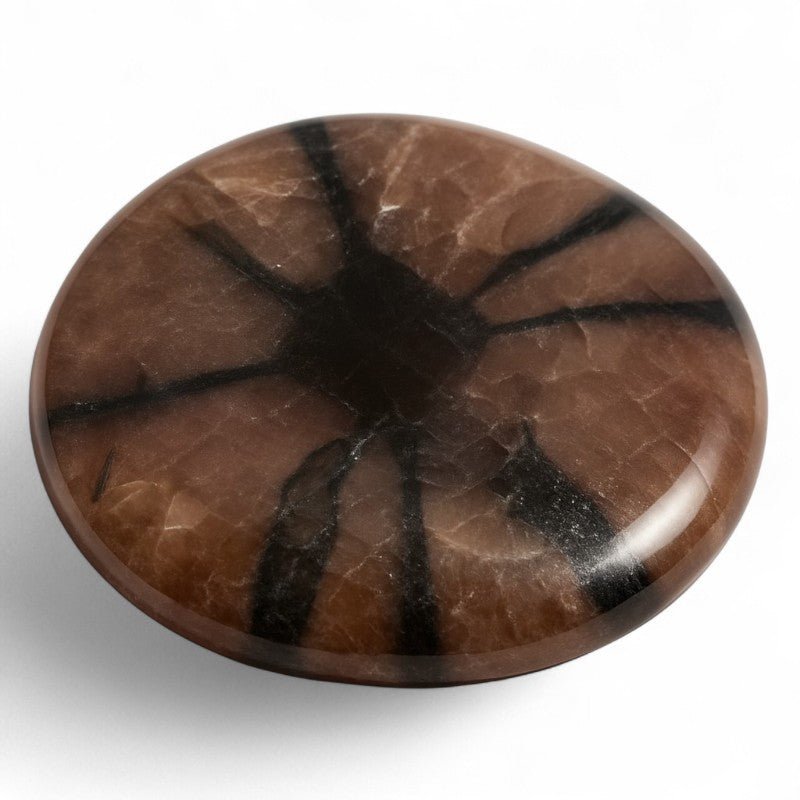
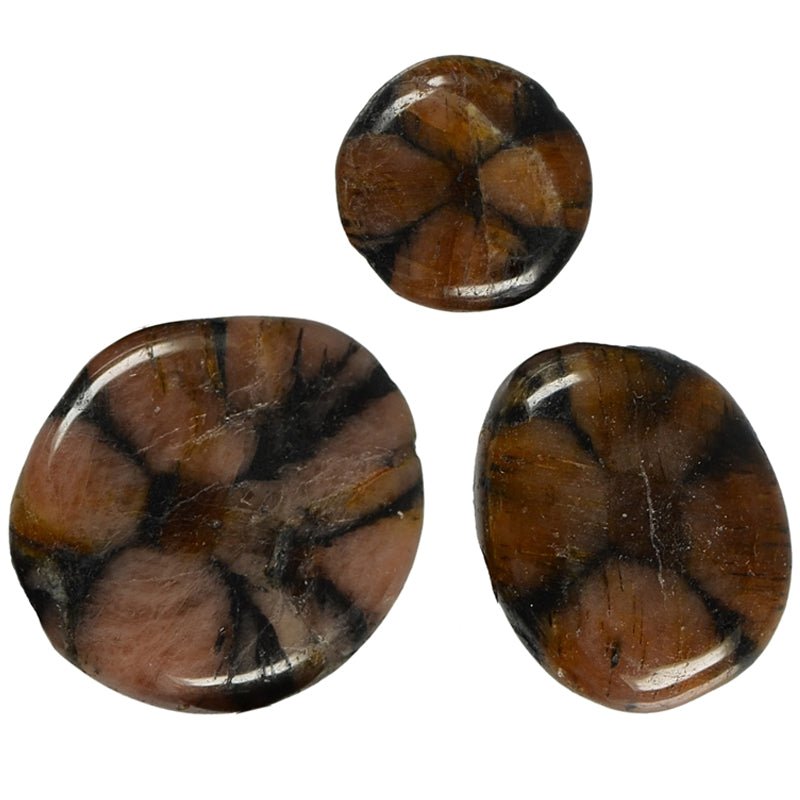
In reality, chiastolite is one of the most widespread species of andalusite. It is distinguished by its dark color, in an orange-brown crystal, and by its cross, formed by inclusions of carbon and clay, hence its Greek etymology.
During archaeological excavations on the Iberian Peninsula, remains of chiastolite were discovered. This suggests that this stone has been used for millennia. In the 18th century, this stone was described by José Torrubia, a Spanish Jesuit naturalist, in his encyclopedia. Furthermore, it is found in abundance in northern Spain. José Torrubia recounts that until the end of the 16th century, this stone was used as an amulet by pilgrims on the Way of St. James (Camino de Santiago). In the past, chiastolite was believed to ward off curses.
In Chile, chiastolite is the origin of various myths among the Mapuche people (meaning “People of the Earth”). This warrior people fiercely defended themselves against attacks by the Incas, and later against those of the Spanish conquistadors, who sought to capture them as slaves. A chiastolite was attributed to the soul of each warrior killed by the Spanish.
During this battle, a young Spanish girl was captured by the Indians, who treated her with respect. Once at their camp, she learned to respect the customs of her captors, and then to appreciate them. As time passed, the young girl fell in love with a warrior from the tribe. They wished to marry, but the entire tribe opposed the union.
Returning to camp after a battle, the young warrior was abducted by members of his tribe and held prisoner in a cave. The young Spanish woman was then told of his death and that her beloved's body lay in the forest. Despairing and weeping uncontrollably, she set out to find him.
Legend has it that the young girl's tears were transformed into chiastolite by the goddess Pachamama (Earth Mother Goddess), who was moved by her despair. This goddess is an important protective deity. She represents fertility, abundance, femininity, and generosity. This miracle moved the rest of the tribe, and a shaman was summoned to find out what Pachamama desired. She ordered that the two lovers be reunited and allowed to marry. Thus, they were able to live their love in peace.
In 1798, Jean-Claude Delamétherie (1743-1817), a French naturalist, mineralogist, and geologist, precisely described samples from Spain, which he named andalousite and chiastolite respectively. He was convinced that these samples originated in Andalusia, whereas in fact they had been found in Castile and had nothing to do with Andalusia.
Chiastolite belongs to the silicate group. It is primarily composed of silicon dioxide and metallic oxides such as aluminum, magnesium, and sodium. It has a hardness of 7.5 on the Mohs scale and also offers high thermal resistance. Thanks to this property, this stone is frequently found in the metallurgical industry.
The main deposits are in China, Australia, Canada, Belgium, France, Russia, etc.
Chiastolite stone facilitates introspection and helps to uncover the blockages at the root of our fears, sometimes buried since birth. It allows for greater self-awareness.
During times of change in life, it helps in making the right decisions and facing the future with serenity. It dispels fears, which can hinder personal growth. It helps in making difficult choices.
It is renowned for its calming and soothing properties. It relieves nervous tension caused by stress, easing muscle contractions and cramps. It has regenerative properties that promote recovery during periods of intense physical and mental fatigue.
This stone is a calming stone that regulates emotional excesses. It provides balance between various emotions. It soothes fears, dispels anxieties and negative feelings.
A magnificent stone of harmony, chiastolite balances emotions and eliminates feelings of guilt. It fosters self-confidence and provides a strong sense of assurance. Thus, it brings serenity, enabling one to overcome life's difficulties.
Color :
Astrological sign:
Stone Type:
Age :
Gender :


Les vertus décrites relèvent de la tradition de la lithothérapie et ne constituent ni un avis médical ni un conseil de santé. En cas de problème de santé, consultez un professionnel.