




Couldn't load pickup availability
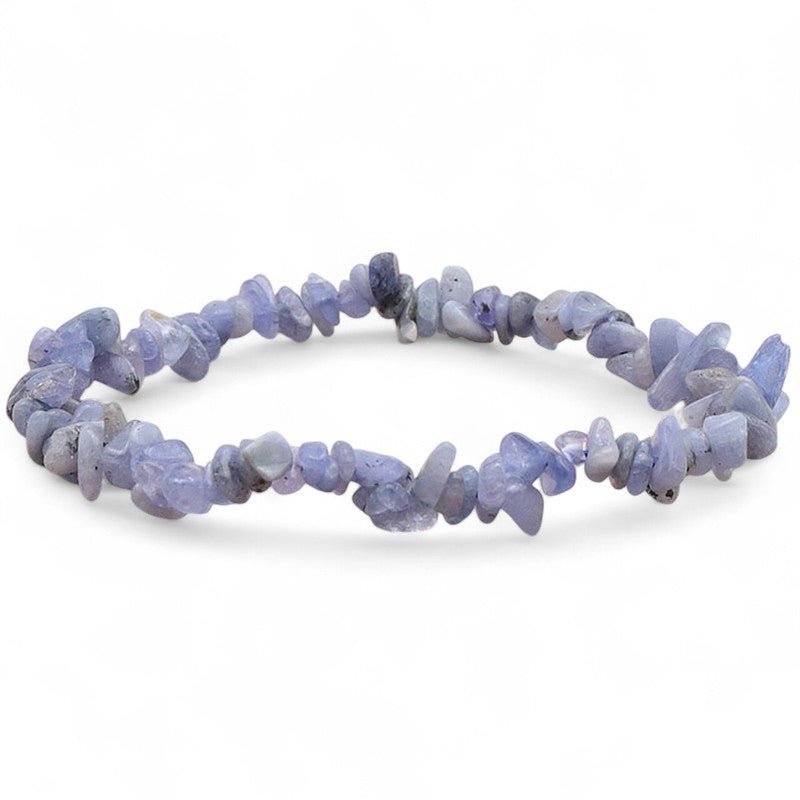
Beautiful natural Tanzanian tanzanite bracelet (grade A), made of polished baroque stones with delicate shades of blue, violet-blue, purple, and lavender.
An iconic and sought-after stone, tanzanite is known for its remarkable color variations. The irregular shapes and natural differences in hue give each bracelet a unique character.
This grade A Tanzanian tanzanite bracelet is made of natural polished baroque-shaped stones.
Tanzanite is the blue-to-violet variety of zoisite, a relatively rare mineral whose commercially significant deposits are associated with a very restricted area in northern Tanzania.
It is distinguished by its magnificent tones ranging from blue to purple, including lavender-blue and violet-blue.
One of tanzanite's unique characteristics is its pleochroism: the stone can reveal different shades when viewed from different orientations or under different lighting.
For this grade A – good quality selection, the stones may show variations in color, transparency, and natural inclusions. These characteristics are particularly visible in baroque beads and contribute to the authentic character of the bracelet.
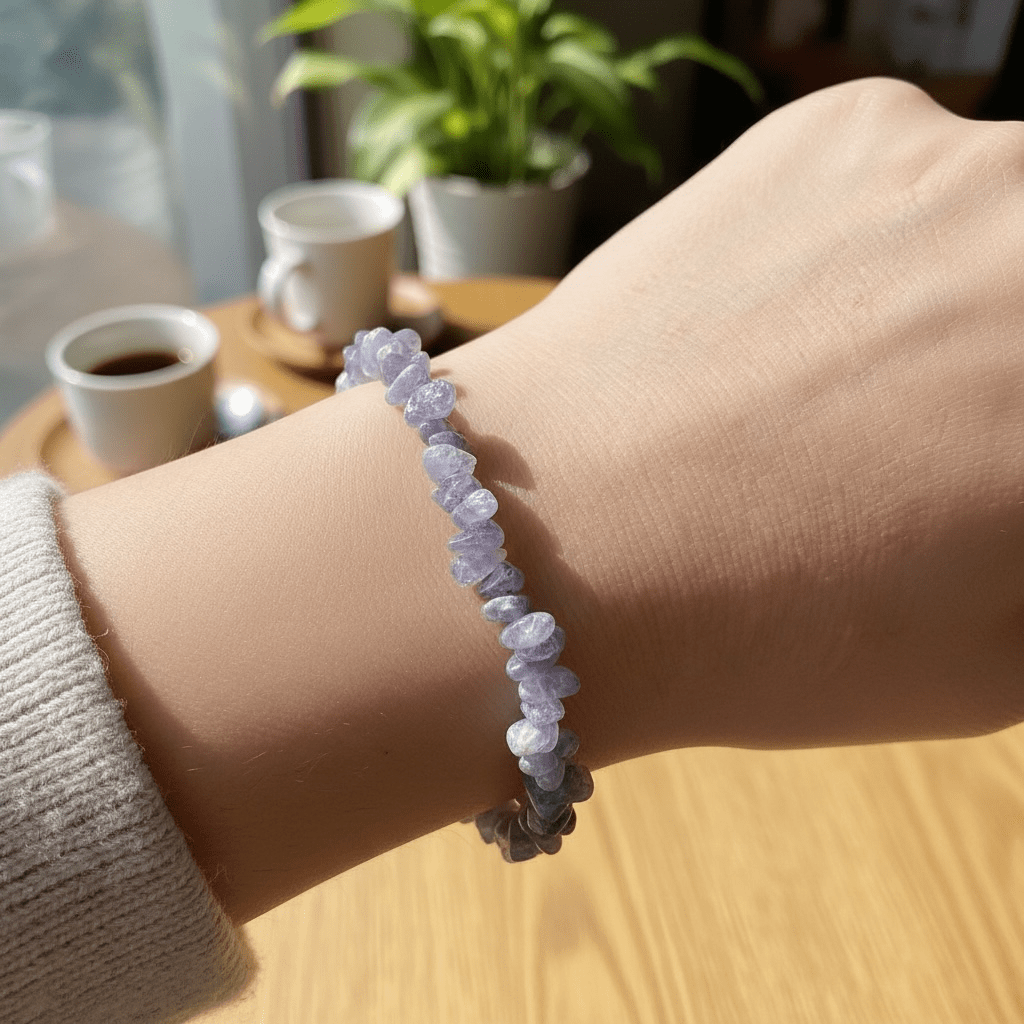
With a length of approximately 17 to 18 cm (6.7 to 7.1 inches), this bracelet is suitable for wrists measuring approximately 17 to 19 cm (6.7 to 7.5 inches). Its weight of approximately 10 g (0.35 oz) ensures a nice presence on the wrist.
The shapes, inclusions, transparencies, and shades of blue and purple may vary from one stone to another and from one bracelet to another. Each piece is unique.
Stone: Tanzanite
Mineral: Zoisite
Variety: Blue-to-violet zoisite
Origin: Tanzania
Grade: A – Good quality
Shape: Polished baroque stones
Dimensions: Approximately 17 to 18 cm (6.7 to 7.1 inches)
Recommended wrist size: 17 to 19 cm (6.7 to 7.5 inches)
Weight: Approximately 10 g (0.35 oz)
Mounting: Elastic bracelet
Colors: Blue, violet-blue, purple, lavender
Special feature: Pleochroic stone with variable shades depending on orientation and lighting
In lithotherapy, tanzanite is traditionally associated with intuition, serenity, and spiritual awakening.
It is said to be particularly valued for symbolically accompanying meditation and introspection, promoting a calmer state of mind conducive to reflection.
Tanzanite is also associated with communication and self-expression. It is traditionally believed to help express thoughts and emotions more easily.
It also holds symbolism related to creativity and open-mindedness, encouraging new perspectives on situations.
In lithotherapy, it is primarily connected to the throat chakra, traditionally associated with communication, as well as the third eye chakra, linked to intuition. It is also sometimes associated with the crown chakra for its spiritual dimension.
The properties attributed to stones come from lithotherapy traditions and beliefs. They do not replace a diagnosis, treatment, or medical advice.
Tanzanite is a blue-to-violet variety of the mineral zoisite.
It therefore belongs to the same mineral species as other varieties of zoisite but is distinguished by its remarkable color.
Its commercial history is relatively recent, as tanzanite only became famous from the second half of the 20th century onwards.
It is now considered a particularly sought-after gemstone in jewelry.
Tanzanite's reputation for rarity primarily stems from its extremely limited geographical distribution.
The deposits that made this stone famous are located in a small area of northern Tanzania, near Kilimanjaro.
This geographical concentration explains why the Tanzanian origin is intrinsically linked to the very name of the stone.
The future availability of deposits is regularly the subject of numerous commercial claims. However, it is best to avoid phrases such as "mines will soon be depleted," which are difficult to guarantee precisely.
Tanzanite's characteristic colors are primarily linked to the presence of vanadium in its structure.
The stone can display tones ranging from blue to purple, with different intensities depending on the specimen.
The observed colors also depend on the stone's orientation and the light under which it is viewed.
It is this chromatic complexity that strongly contributes to its interest in gemology.
Tanzanite exhibits marked pleochroism.
This means it can show different colors depending on the orientation from which it is viewed.
Depending on the stones, it is possible to observe different components of blue, purple, and sometimes warmer tones.
On baroque stones, whose surfaces are not oriented like those of a faceted gemstone, these variations can give the bracelet a beautiful diversity of shades.
This is an important point for your product sheet.
A large proportion of tanzanites on the market are heated to enhance or stabilize their blue and purple tones.
Heating tanzanite is a common practice in the gemstone trade.
If your supplier does not explicitly guarantee unheated tanzanite, I advise you not to use the mention "untreated."
You can perfectly refer to natural tanzanite, which means the stone is of natural origin, even if it has potentially undergone heat treatment.
The name tanzanite is historically and commercially associated with the blue-to-violet zoisites discovered in Tanzania.
The most famous deposits are located in the Merelani region, in the north of the country.
This extremely localized geographical origin strongly contributes to the stone's reputation and value.
Tanzanite and blue sapphire can sometimes exhibit similar colors, but they are two completely different stones.
Tanzanite is a variety of zoisite.
Sapphire is a variety of corundum.
Sapphire is also much harder: approximately 9 on the Mohs scale, compared to approximately 6 to 7 for tanzanite.
Tanzanite therefore requires more care when worn as jewelry.
Iolite is another stone that can exhibit beautiful blue-to-violet shades as well as marked pleochroism.
However, it is a different mineral: iolite corresponds to the gem variety of cordierite.
Tanzanite, on the other hand, belongs to the zoisite family.
Their color can sometimes be similar, but their mineralogical properties are different.
They are not really two independent stones.
Tanzanite is a particular variety of zoisite, characterized by its blue-to-violet colors.
Therefore, not all zoisites are tanzanites.
Zoisite can also exhibit other colors and is notably found in the material known as ruby in zoisite.
This bracelet is offered in grade A – good quality.
The stones may therefore show more variations in shade, opacity, and inclusions than a higher gem-quality selection.
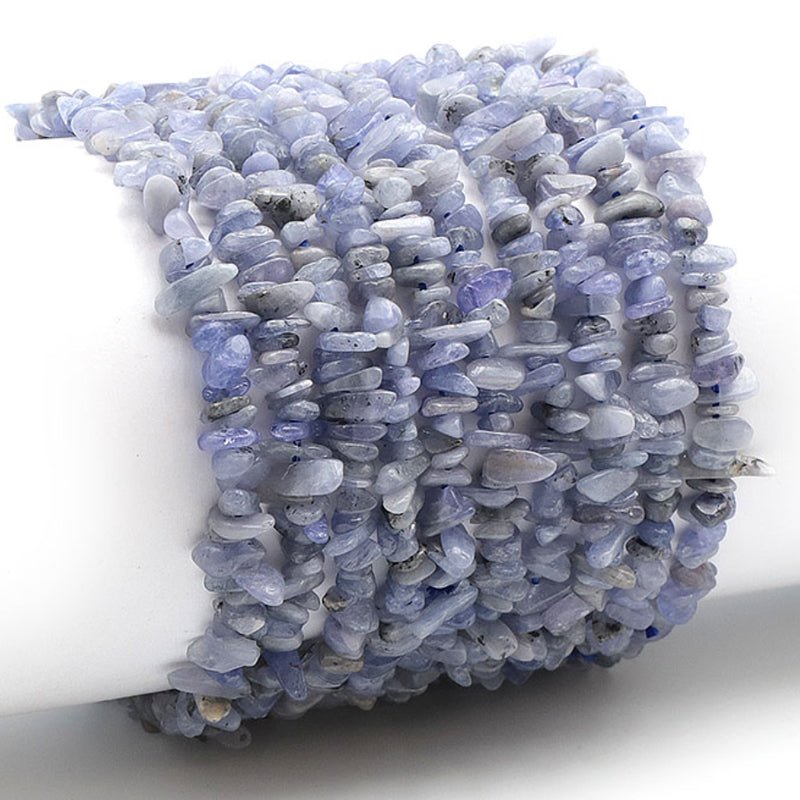
Some beads may be a relatively intense violet-blue, while others will be paler, grey-blue, or lavender.
These differences are particularly well-suited to the aesthetics of baroque stones and allow natural tanzanite to be offered in a more accessible range.
It is useful to remember that the commercial designations A, AA, or AAA do not correspond to a standardized international gemological classification.
Baroque stones have irregular shapes, unlike perfectly round and calibrated beads.
This finish allows the natural appearance of tanzanite to be better preserved.
Each stone has its own combination of shape, color, transparency, and inclusions.
The distribution of blue, purple, or lavender shades can therefore vary significantly from one bracelet to another. The received bracelet may naturally differ from the photographs shown.
Tanzanite is a stone that requires more care than quartz or spinel.
Avoid shocks, sudden temperature changes, and contact with chemicals, perfumes, and household products.
Ultrasonic and steam cleaners are not recommended.
For routine cleaning, use a soft, slightly damp cloth, then carefully dry the stones.
Preferably remove your bracelet before showering, swimming, cleaning, playing sports, or any activity likely to cause impacts.
Color :
Astrological sign:
Stone Type:
Age :
Gender :


The properties described come from the tradition of crystal healing and are neither medical advice nor health advice. For any health problem, consult a professional.