Skip to product information
1 of 4

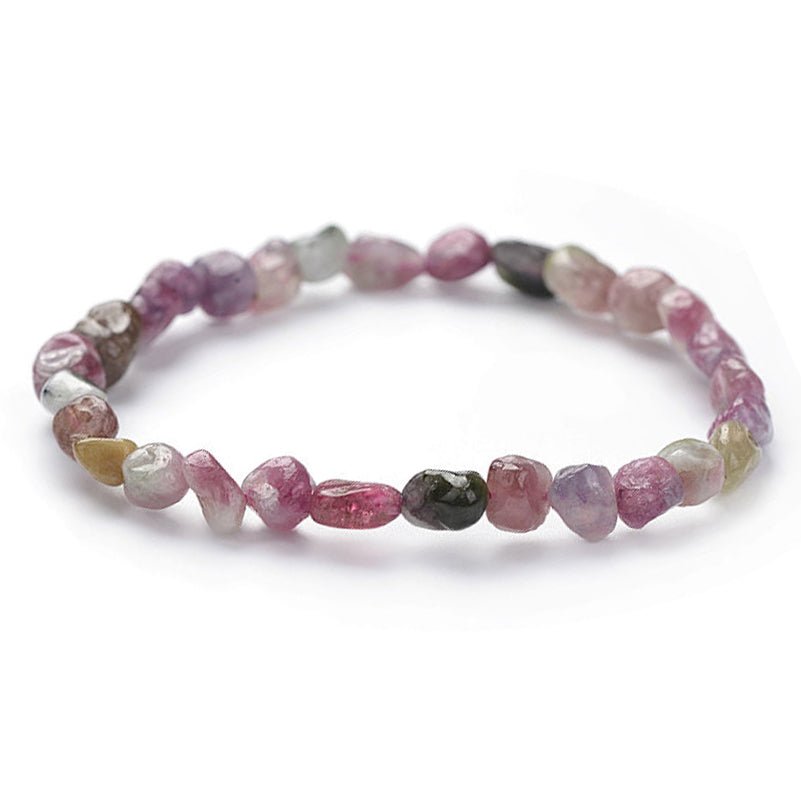
Multicolored tourmaline bracelet Brazil A (grains 5-7mm)

Regular price
14,90 €
Regular price
Sale price
14,90 €
Tax included. Shipping calculated at checkout.
OFFRE BIENVENUE
Appuyer sur le code pour copier
Livraison 24/48h offerte dès 50€ d'achat
Satisfait ou remboursé 15 jours pour changer d'avis
Paiement sécurisé
+ 11 000 avis
sur Vérifiés
  • Hurry, only 1 item left in stock!
Learn more

BRA-TOUR-24
Origin: Brazil
Grade: A

Dimensions:
Approximately 18cm - Suitable for all wrists from 17 to 19cm

Weight:
Approximately 15g

Origin:
Brazil

Quality:
A = good

Beautiful bracelet composed of small tumbled stones (5-7mm) of multicolored tourmaline.
Patterns and colors may vary from one bracelet to another.

The name tourmaline comes from "turmali" or "turamali", which is actually a Sinhalese name given to this fabulous stone from Sri Lanka by Dutch explorers in the early 18th century.

In Sri Lanka, a legend says that tourmaline came from the sky and, during its descent to earth, passed through a rainbow that gave it its color variations. This explains the origin of its name, meaning "the stone of a thousand colors".

In fact, tourmaline has been known for millennia. Traces of this stone can be found in the 3rd century BC. In Greece, Alexander the Great (356-323 BC) brought this stone back from his expeditions. However, tourmaline, due to its many colors, has very often been confused with other minerals.

Thus, there are very few legends or myths attached to this stone due to its late identification. However, some tourmalines have piezoelectric properties, meaning they possess an electrical charge, negative at one pole and positive at the other. Tourmaline attracts particles to itself.

When the philosopher Theophrastus (-322 to -288) described a stone with the ability to attract pieces of straw or wood to itself, we understand that he was talking about tourmaline. Later in the 18th century, Dutch explorers used tourmaline to clean their pipes, as the stone attracted ashes.

As an anecdote, in the 16th century, a Spanish conquistador discovered a green tourmaline in Brazil, which he identified as an emerald. This discovery caused a rush in the Brazilian regions in search of these famous emeralds. The error was corrected in the 19th century, and the emeralds were transformed into tourmalines.

Often confused with precious stones, tourmalines are therefore found in many jewels, and even in the British crown. We can also mention the Timur Ruby, a 352-carat jewel thought to be a ruby until 1851, or the 170-carat Black Prince's Ruby, which is actually a tourmaline.

Tourmaline is increasingly popular with connoisseurs and collectors. Thus, Empress Cixi of China (1861-1908) loved this stone so much that she began to collect it. She asked for sculptures, brooches, watch clasps, rings, etc., to be made for her. Today, she rests on a cushion of tourmalines.

The main deposits are located in Brazil, Afghanistan, Australia, Russia, Thailand, Burma, Madagascar, India, and the United States.

Tourmalines come in various shades. They can also be bicolored or multicolored. There is a wide variety of tourmalines, of different colors, from opaque to transparent, with striated or hexagonal structures. They have a rhombohedral crystal system. It is a magmatic and metamorphic rock that can come from hydrothermal deposits.

Thus, tourmalines have varied compositions such as silicates of magnesium, sodium, iron, clay, fluorides, and borosilicate. Tourmalines are actually an entire family of stones that have the same internal structure but differ in chemical composition and therefore in color and appearance.

The tourmaline family is an attractive variety in the world of fine stones. They crystallize in all possible colors. They are highly valued in jewelry because of their high hardness (7 to 7.5). They have resplendent hues and exceptional brilliance.

The strong birefringence of tourmalines means that two tourmalines are practically never the same color. Jewelers-designers can therefore offer unique creations of great originality. Gem-quality tourmaline (transparent) will be facet-cut, in various shapes (pear, oval, round, etc.). Translucent to opaque tourmaline of well-defined colors will be cut into cabochons or polished slices.

Tourmalines come in various colors and can thus be combined when creating bracelets or necklaces. Let's look back at the most used ones.

Blue tourmaline

Blue tourmaline is also called indigolite or indicolite. It is a stone with a light blue to dark blue color. It differs from other tourmalines by having a transparent appearance in its raw form.

In lithotherapy, it is a stone of appeasement and serenity. It frees the mind from negative thoughts. It encourages fidelity in love and friendship and honesty. Blue tourmaline dissipates feelings of sadness, unease, and despair to make way for positive feelings.

Its astrological signs: Sagittarius, Aquarius, Pisces

Its chakra: the throat chakra

Brown tourmaline

Brown tourmaline or dravite is a variety of tourmaline of brown or mahogany color, sometimes so dark that it is confused with black tourmaline. It is a mineral of the cyclosilicate family, hydroxylated with sodium, aluminum, and magnesium.

In lithotherapy, it helps to overcome life's difficulties and gives the courage to accept the unthinkable. It allows one to make peace with one's past and to identify the origin of certain blockages often linked to childhood. Brown tourmaline is a stone rich in magnesium. It allows its wearer to better absorb magnesium during supplementation cures.

Its astrological signs: Aries, Virgo, Scorpio

Its chakra: the root chakra

Yellow tourmaline

There are different varieties of yellow tourmalines (Malawi tourmaline, elbaite, tsilaisite, etc.).

It should be noted that yellow tourmaline is among the most expensive varieties of tourmalines. The price of these yellow tourmalines varies according to their quality, purity, origin, and weight. A tourmaline mounted on a ring can reach several hundred euros.

In lithotherapy, yellow tourmaline is appreciated for its energizing virtues. It is a stone of dynamism and vitality. It allows morally and physically tired people to regain energy and the will to achieve their goals. An anti-stress stone, it also helps to overcome states of intense sadness.

Its astrological signs: Taurus, Leo, Libra

Its chakra: the solar plexus chakra

Black tourmaline

Black tourmaline is the most well-known variety of tourmaline. It is also identified as schorl. It is said to be black, but it can also be dark brown. It has gained its notoriety over time due to its many properties.

It is the most common tourmaline and can sometimes measure up to 2 m high. Its composition, very rich in iron, gives it this black, opaque, and intense appearance.

In lithotherapy, black tourmaline is a very powerful grounding stone. It helps to keep one's feet on the ground, calms scattered thoughts, and refocuses attention. A formidable anti-stress stone, black tourmaline diffuses energy and vitality.

Its astrological signs: Cancer, Sagittarius, Capricorn

Its chakra: the root chakra

Cat's eye tourmaline

Cat's eye tourmaline is one of the rarest varieties of tourmalines. It bears this name due to the phenomenon of light reflection that resembles a cat's slit eye. This phenomenon is called chatoyancy.

This optical peculiarity is exceptionally rare and is found only in a handful of fine stones. It is caused by the presence of tiny parallel fibers or needle-shaped inclusions in the stone.

In lithotherapy, cat's eye tourmaline, like many other tourmalines, repels negative energies. It is an excellent protective stone that helps to ward off people with bad influences. It is also known to strengthen the immune system and to facilitate the good circulation of bodily fluids.

Its astrological signs: Leo, Libra, Aquarius

Its chakra: the sacral chakra

Pink tourmaline

Pink tourmaline (or rubellite when it approaches red) is composed of complex silicates of borosilicates, iron, alkalis, and magnesium. It also contains a high content of copper and manganese, which gives it this magnificent pink color. Pink tourmaline can be transparent, translucent, or even opaque.

Pink tourmaline is a stone often associated with other minerals. The most common associations are pink tourmaline on eudialyte, pink tourmaline on lepidolite, and pink tourmaline on rose quartz.

In lithotherapy, pink tourmaline is closely related to feelings of love and tenderness. It emits vibrations that help to restore and protect psychological well-being. Pink tourmaline brings serenity and allows its wearer to effectively combat stress and its consequences on the body.

Its astrological signs: Aries, Libra, Scorpio

Its chakra: the heart chakra

Green tourmaline

Green tourmaline is also found under the name verdelite. It comes in different shades of green, with this transparent aspect. Green tourmaline is the most common after black. More rarely, other green tourmalines can be found, such as chromiferous ones. These are rarer and more sought after.

In lithotherapy, the beautiful green colors of this tourmaline evoke the greens present in nature during spring, the season of renewal. It is then said that green tourmaline is excellent for all people who wish to start from scratch. It gives them the strength to leave a toxic relationship, an ungrateful job, etc. Placing a green tourmaline in a bedroom helps to ward off agitated thoughts at bedtime. A softness sets in and promotes falling asleep.

Its astrological signs: Libra, Capricorn, Pisces

Its chakra: the frontal chakra

Want to know more about this stone? Discover all the virtues of black tourmaline and explore our black tourmaline bracelets.

Features

Color :

  • Multicolor

Astrological sign:

  • Scorpio

Stone Type:

  • Rolled Stones

Age :

  • Adults

Gender :

  • Unisex
Bracelet tourmaline multicolore Brésil A (grains 5 - 7mm) - La Boite à Cailloux

+11,700 satisfied customers… and you, what are you waiting for?

  • 100% SECURE PAYMENT

    Paypal, credit card, check, transfer

  • FREE DELIVERY

    from 40€ purchase

  • SATISFIED OR REFUNDED

    14 days to change your mind

  • CUSTOMER SERVICE AVAILABLE

    contact@laboiteacailloux.com