



Couldn't load pickup availability
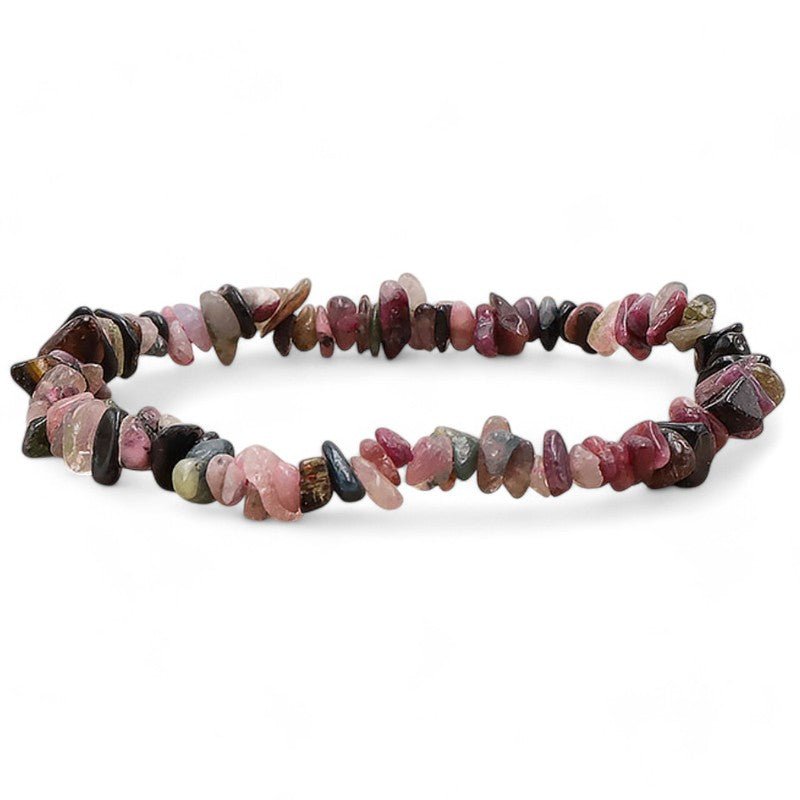
Beautiful A-grade multicolor tourmaline bracelet from Brazil, made of natural baroque beads offering a superb diversity of colors: pink, green, yellow, brown, black, and intermediate shades.
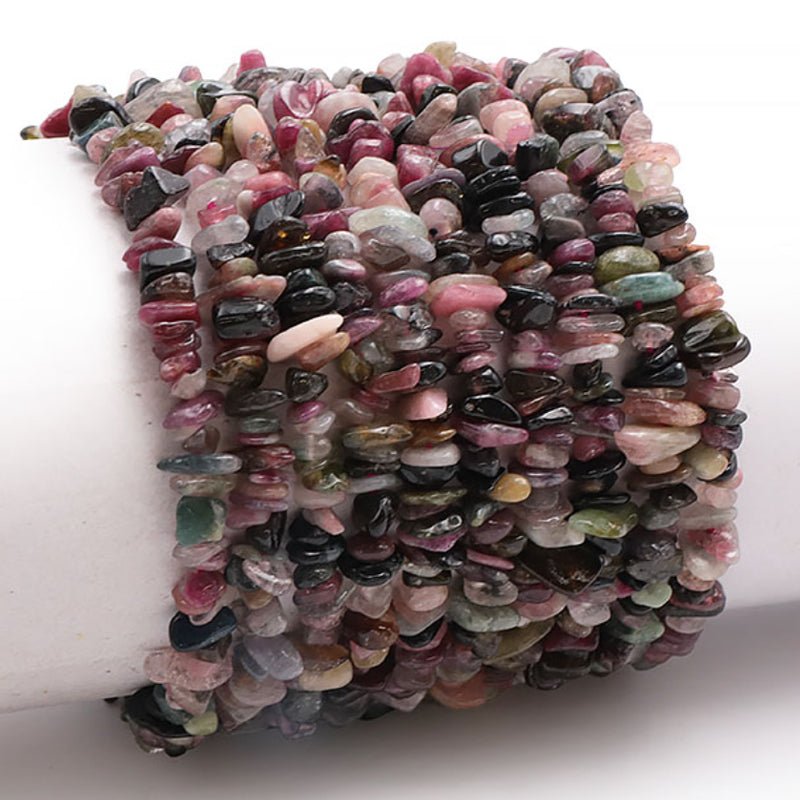
Each tourmaline has its own hue and inclusions. The combination of these different colors and the irregular shapes of the baroque beads results in a colorful, natural, and unique bracelet.
This A-grade multicolor tourmaline bracelet from Brazil – good quality is made of polished natural stones in a baroque shape.
Tourmaline refers to a complex group of minerals renowned for its extraordinary diversity of colors. It can be black, green, pink, red, blue, yellow, brown, or exhibit multiple colors within the same crystal.
This chromatic richness makes multicolor tourmaline a particularly interesting stone in jewelry. Within the same bracelet, the beads can display very different tones, creating a naturally colorful piece of jewelry without losing its mineral character.
Brazil is globally known for its numerous tourmaline deposits and has provided remarkable specimens in a very wide variety of colors.
Baroque beads have naturally irregular shapes. Some may be more translucent while others are more opaque or contain visible inclusions.
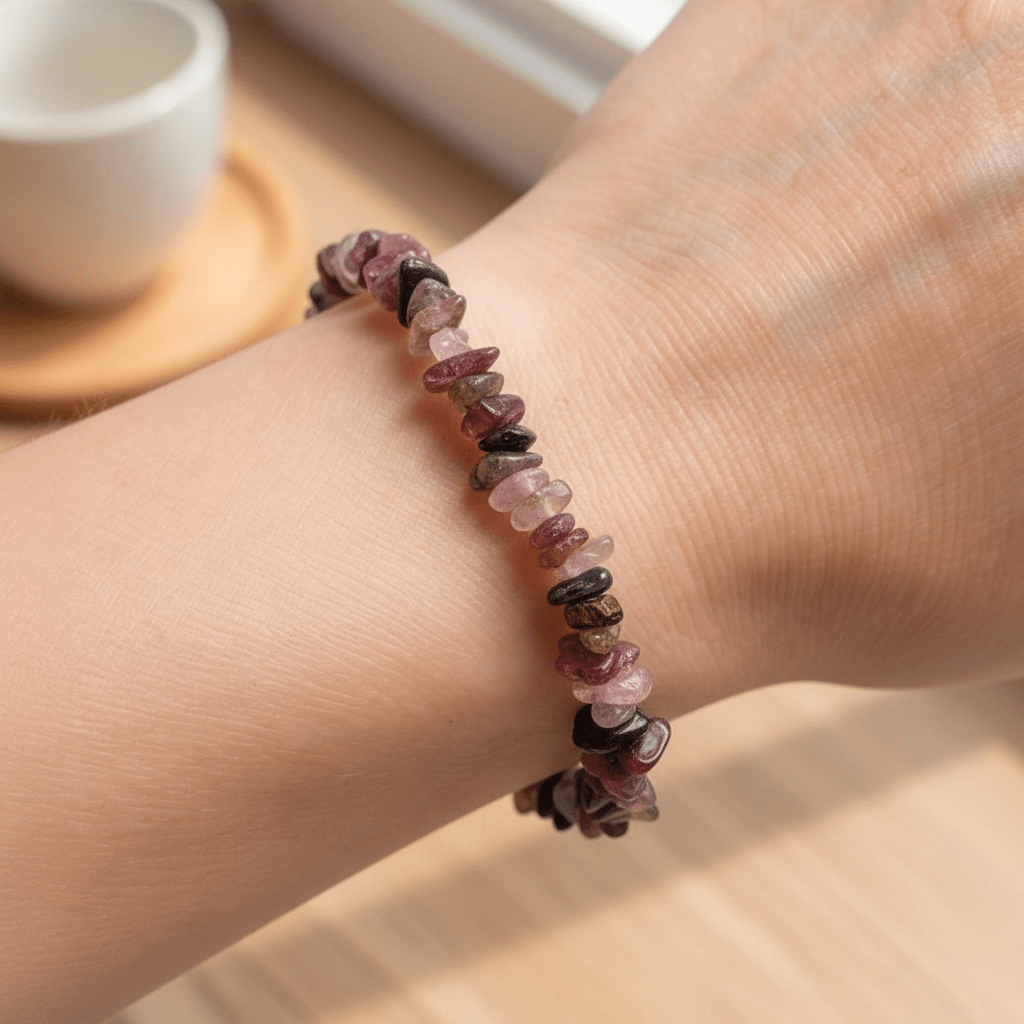
With a length of approximately 17 to 18 cm, this elastic bracelet is suitable for wrists measuring approximately 16 to 18 cm. Its light weight of about 7 g makes it easy to wear daily.
The distribution of colors, shapes, inclusions, and transparency of the stones can vary significantly from one bracelet to another. Each item is unique.
Stone: Multicolor Tourmaline
Family: Tourmaline group
Origin: Brazil
Grade: A – Good quality
Shape: Polished baroque beads
Dimensions: Approximately 17 to 18 cm
Recommended wrist size: 16 to 18 cm
Weight: Approximately 7 g
Mounting: Elastic bracelet
Colors: Pink, green, yellow, brown, black, and various shades
Hardness: Approximately 7 to 7.5 on the Mohs scale
Special feature: Natural association of tourmalines of different colors
In lithotherapy, multicolor tourmaline is traditionally associated with balance, harmony, and protection.
The presence of several colors also symbolically combines the properties traditionally attributed to different varieties of tourmaline.
Pink tourmaline is associated with love, gentleness, emotional soothing, and self-acceptance.
Green tourmaline is traditionally linked to balance, vitality, and emotional harmony.
Black tourmaline is one of the most well-known stones in lithotherapy for grounding and symbolic protection against negative energies.
Yellow to brown tourmalines are more associated with confidence, stability, and personal energy.
Thanks to this diversity, the multicolor tourmaline bracelet is often chosen as a stone for general harmonization, symbolically allowing work on multiple emotional dimensions.
Depending on the colors present, multicolor tourmaline can be associated with several chakras, which explains why it is sometimes considered a stone for harmonizing all energetic centers.
The properties attributed to stones come from lithotherapy traditions and beliefs. They do not replace a diagnosis, treatment, or medical advice.
Unlike some stones corresponding to a single mineral species, the term tourmaline refers to a group of minerals with complex chemical compositions.
The different species in the group can exhibit an extraordinary diversity of colors.
This chromatic richness is one of tourmaline's main characteristics and explains its importance in gemology, mineralogy, and jewelry.
Tourmaline crystals frequently have an elongated shape with characteristic parallel striations when observed in their rough state.
Tourmaline has a particularly complex and variable chemical composition.
Different elements can enter its structure and influence its color.
Iron, manganese, chromium, or vanadium, among others, can contribute to the coloration of certain tourmalines.
It is this great chemical diversity that allows the tourmaline group to present an exceptionally wide range of colors.
Yes. This is even one of the most fascinating characteristics of some tourmalines.
During the crystal's growth, chemical conditions can evolve. The tourmaline's composition then gradually changes, and different color zones can appear within the same crystal.
Some tourmalines are thus bicolor or multicolor.
The most famous example is probably the watermelon tourmaline, which typically combines a pink core with a green outer zone.
Tourmaline has many varieties and appellations used in gemology and trade.
Rubellite generally refers to the highly sought-after intense pink to red tourmalines.
Indicolite corresponds to tourmalines with blue colors.
Verdelite is an appellation traditionally used for certain green tourmalines.
Schorl, or black tourmaline, is one of the most common varieties.
Elbaite is a species of the group particularly known for producing gem-quality crystals with extremely varied colors.
Brazil is one of the most famous countries in the world for its tourmalines.
Brazilian pegmatites have provided crystals exhibiting an extraordinary variety of colors: green, pink, red, blue, yellow, or multicolor.
The state of Minas Gerais, in particular, is globally known for its many gemstones and tourmaline deposits.
Brazil is also famous for certain tourmalines with extremely intense blue-green colors discovered at the end of the 20th century.
Paraíba tourmaline is a particularly sought-after variety typically exhibiting electric blue, turquoise, or neon green colors due notably to the presence of copper.
The first famous specimens were discovered in the state of Paraíba in Brazil.
Not all blue or green tourmalines from Brazil are, of course, Paraíba tourmalines. This appellation has a specific gemological meaning and should only be used when the identification of the material justifies it.
Multicolor tourmaline generally refers to tourmalines exhibiting or combining several colors.
Watermelon tourmaline corresponds to a particular type of color zoning reminiscent of a watermelon slice, usually with pink and green.
A bracelet combining different pink, green, brown, or yellow beads can therefore be described as multicolor tourmaline without necessarily being composed of watermelon tourmaline.
Not all pink tourmalines are automatically rubellites.
The term rubellite is traditionally reserved for tourmalines exhibiting intense pink, rosy red to red colors, with certain color characteristics sought after in gemology.
For an A-grade multicolor bracelet, it is therefore safer to simply speak of pink tourmaline when precise identification as rubellite is not guaranteed.
Some high-quality green tourmalines can present a color intense enough to evoke emerald.
However, these are two entirely different stones.
Tourmaline belongs to the tourmaline group, while emerald is a green variety of beryl.
Their chemical composition, optical properties, and crystal structure are therefore different.
Tourmaline should not be confused with tourmalinated quartz.
A tourmaline consists of the mineral itself.
Tourmalinated quartz, on the other hand, is a quartz containing inclusions of tourmaline crystals, usually visible as dark needles or rods.
Both materials can therefore contain tourmaline, but their composition and appearance are very different.
This bracelet is offered in grade A – good quality.
The stones may exhibit different color intensities as well as variations in transparency and natural inclusions.
Some beads may be more translucent and luminous, while others will have a darker color or more inclusions.
On a multicolor bracelet, these differences are precisely an important part of its aesthetic appeal.
Classifications A, A+, AA, or AAA do not correspond to a standardized international gemological scale. They primarily serve to distinguish several levels of selection offered by a supplier or seller.
Baroque beads have irregular shapes, unlike perfectly round and calibrated beads.
This finish allows for a greater preservation of the natural aspect of the tourmalines and gives the bracelet a particularly vibrant aesthetic.
The proportion of pink, green, yellow, brown, or black can vary considerably between items.
One bracelet may thus be more dominated by pink and green tones, while another will contain more dark stones.
The distribution of colors, patterns, inclusions, and shapes can therefore vary significantly compared to the photographs presented. Each bracelet is unique.
With a hardness of approximately 7 to 7.5 on the Mohs scale, tourmaline has good resistance for use in jewelry.
It should nevertheless be protected from significant impacts and sudden changes in temperature.
Also avoid contact with chemicals, perfumes, cosmetics, and household products.
For routine cleaning, simply use a soft, slightly damp cloth, then carefully dry the stones.
To also preserve the elastic thread, preferably remove your bracelet before showering, swimming, cleaning, or sporting activities.
Color :
Astrological sign:
Stone Type:
Age :
Gender :


Les vertus décrites relèvent de la tradition de la lithothérapie et ne constituent ni un avis médical ni un conseil de santé. En cas de problème de santé, consultez un professionnel.