


Couldn't load pickup availability
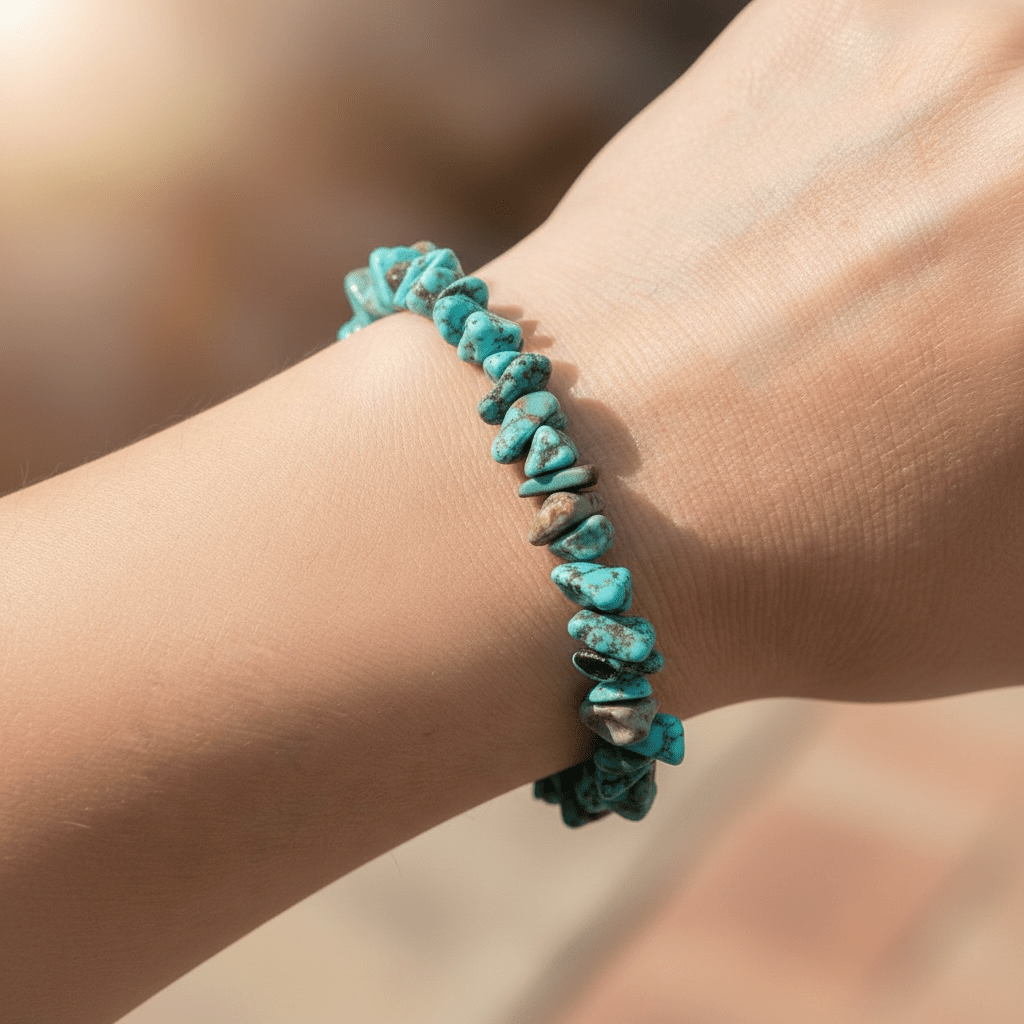
Beautiful A+ grade Tibetan turquoise bracelet, made of baroque beads with superb shades of turquoise blue, blue-green, and green, naturally streaked with brown, beige, or dark matrices.
Valued for its authentic appearance and characteristic patterns, Tibetan turquoise has a long history in Central Asia and Tibetan culture. Since each stone has its own colors and matrix, each bracelet is unique.
This A+ grade Tibetan turquoise bracelet – high quality – is composed of polished baroque-shaped stones.
Turquoise is a natural mineral belonging to the phosphate family. It is primarily composed of hydrated copper and aluminum phosphate. Copper plays an essential role in the famous characteristic blue tones of this stone.
Tibetan turquoise is often distinguished by a wide diversity of colors, ranging from sky blue to blue-green and green, as well as a particularly visible matrix.
These veins and matrix areas can exhibit different shades of brown, beige, gray, or black, creating unique patterns within each stone.
Turquoise also holds a special place in Tibetan culture, where it has long been used for making jewelry and ornaments.
The baroque shapes of this bracelet particularly highlight the natural variations of the stone and give it an authentic character.
With a length of approximately 17 to 18 cm (6.7 to 7.1 inches), this bracelet is suitable for wrists measuring approximately 16 to 18 cm (6.3 to 7.1 inches). Its weight of about 10 g (0.35 oz) allows for comfortable daily wear.
The shapes, shades of blue and green, matrices, and patterns can vary significantly from one stone to another and from one bracelet to another. Each item is unique.
Stone: Turquoise
Commercial Name: Tibetan Turquoise
Mineral Family: Phosphates
Indicated Origin: Tibet
Grade: A+ – High Quality
Shape: Polished baroque beads
Dimensions: Approximately 17 to 18 cm (6.7 to 7.1 inches)
Recommended Wrist Size: 16 to 18 cm (6.3 to 7.1 inches)
Weight: Approximately 10 g (0.35 oz)
Assembly: Elastic bracelet
Colors: Turquoise blue, blue-green, green, and variable matrix
Hardness: Approximately 5 to 6 on the Mohs scale
Special Feature: Natural color variations and frequent presence of a contrasting matrix
In lithotherapy, turquoise is traditionally considered an important stone for protection, communication, and balance.
It is believed to symbolically promote a feeling of serenity and calm, especially during periods of change or tension.
Turquoise is also closely associated with communication and self-expression. It is traditionally chosen to encourage more natural speech and facilitate the expression of thoughts and emotions.
It also carries a strong symbolism of protection, particularly in several cultures where it has been worn as amulets and jewelry.
Turquoise is also associated with friendship and sincere relationships. It symbolizes kindness, generosity, and harmony in interactions with others.
In lithotherapy, it is primarily linked to the throat chakra, traditionally associated with communication and self-expression.
The properties attributed to stones come from the traditions and beliefs of lithotherapy. They do not replace a diagnosis, treatment, or medical advice.
Turquoise is a natural mineral belonging to the phosphate group.
Its composition primarily includes copper and aluminum, as well as water and phosphate and hydroxyl groups.
It generally forms in arid regions when copper-rich solutions circulate through certain rocks and interact with other elements present in the subsoil.
Unlike many transparent gemstones, turquoise is generally opaque.
It has been used for several millennia for making jewelry, decorative objects, and amulets.
The color of turquoise depends notably on its chemical composition.
Copper is primarily responsible for its famous blue tones.
Depending on its composition and associated elements, the stone can evolve towards more blue-green or green colors.
Turquoise thus presents a much wider palette than a simple uniform turquoise blue.
Natural nuances are precisely among the aesthetic criteria for distinguishing different turquoises.
The matrix refers to parts of the host rock or other materials naturally associated with turquoise.
It can form veins, networks, or spots of brown, beige, gray, or black color.
Some turquoises show very little matrix while others have extremely pronounced patterns.
These patterns are particularly appreciated on certain Asian and American turquoises.
On baroque beads, the matrix strongly contributes to giving each stone its unique appearance.
The term "Tibetan turquoise" is widely used in trade to refer to turquoises associated with Tibet and, more broadly, certain Himalayan or Asian regions.
They frequently exhibit colors ranging from blue-green to green, with a particularly visible matrix.
However, it is important to be precise with the notion of provenance: "Tibetan turquoise" can sometimes be used as a commercial or cultural designation and does not necessarily guarantee that the stone was extracted within the current geographical boundaries of Tibet.
If your supplier has precise traceability of the deposit, this information can be usefully added to the product sheet.
Turquoise holds an important place in Tibetan ornamental tradition.
It has long been used in the manufacture of jewelry, amulets, and ornaments, often associated with other materials like coral.
Its color and symbolism have made it a particularly appreciated stone in this region of the world.
This cultural dimension still contributes to the particular reputation of turquoises associated with Tibet.
It is important to distinguish between these two terms.
Tibetan turquoise, when it corresponds to the mineral turquoise, is a true turquoise belonging to the phosphate family.
"African turquoise" or "African turquoise" sold as beads is generally another material, often presented as a variety of jasper.
The word "turquoise" therefore does not have the same meaning in these two commercial appellations.
Turquenite is not natural turquoise.
It is a commercial term generally used for howlite or magnesite dyed blue to achieve an appearance resembling turquoise.
Genuine turquoise has a specific mineralogical composition.
The difference is therefore fundamental: turquoise is a natural mineral in its own right, while turquenite generally corresponds to another stone that has been colored.
The United States, particularly Arizona, is world-famous for its turquoises.
Some American turquoises exhibit a particularly intense blue, while others also have a significant matrix.
Turquoises marketed as Tibetan are often appreciated for their greener or blue-green tones and their contrasting matrices.
However, color alone can never definitively determine the geographical origin of a turquoise.
This is a particularly important point for a turquoise product sheet.
Turquoise is a relatively porous stone, and many turquoises sold in jewelry can undergo stabilization, generally intended to improve their solidity and resistance.
Some stones can also be dyed or impregnated to improve their appearance.
A stabilized turquoise remains a natural turquoise that has undergone treatment. It should not be confused with an imitation or a different stone dyed blue.
If your supplier does not explicitly guarantee untreated natural turquoise, I advise you not to use the terms "untreated," "unstabilized," or "100% natural color."
Identifying turquoise by eye alone can be difficult.
Natural turquoise can exhibit significant variations in color, matrix, porosity, and texture.
Numerous imitations also exist: dyed howlite or magnesite, reconstituted materials, resins, and other artificial products.
Color or the presence of veins are therefore not sufficient to guarantee identification.
For a high-value turquoise, a gemological analysis remains the most reliable method for determining the nature of the stone and, in some cases, detecting treatments.
This bracelet is offered in A+ grade – high quality.
The stones present a beautiful general appearance while retaining the color and matrix variations that make turquoise so charming.
Some beads may be more blue, others blue-green or green, while the quantity and color of the matrix may also vary.
These differences are not necessarily flaws: they contribute to the visual identity of each stone.
Commercial classifications A, A+, AA, or AAA do not correspond to a standardized international gemological scale. They primarily serve to distinguish different levels of selection from a supplier or seller.
Baroque beads have irregular shapes, unlike perfectly round and calibrated beads.
This finish is particularly interesting for turquoise because it highlights its many natural variations.
Each stone has its own combination of shape, color, and matrix.
Some beads may be relatively uniform while others will show particularly prominent veining.
The distribution of colors, shapes, and patterns can therefore vary significantly from one bracelet to another. The bracelet received may naturally differ from the photographs presented.
Turquoise has a hardness of approximately 5 to 6 on the Mohs scale and requires more precautions than stones like quartz or tourmaline.
Avoid shocks and contact with perfumes, cosmetics, creams, household products, and other chemical substances.
As turquoise can be porous, it is also best to avoid prolonged immersion in water.
Do not use an ultrasonic cleaner or steam.
For routine cleaning, use a soft dry or very slightly damp cloth, then immediately dry the stones.
Remove your bracelet before showering, swimming, cleaning, sports, or applying perfume and cream.
Turquoise is an exceptional stone, renowned for its beneficial energy. Discover our other turquoise bracelets too.
Color :
Astrological sign:
Stone Type:
Age :
Gender :



The properties described come from the tradition of crystal healing and are neither medical advice nor health advice. For any health problem, consult a professional.