


Couldn't load pickup availability
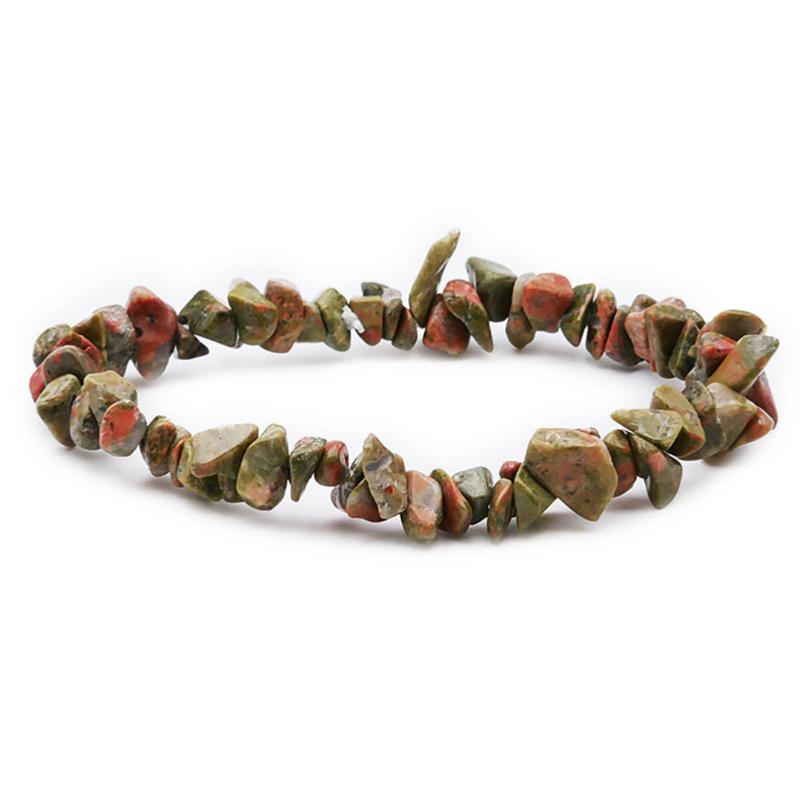
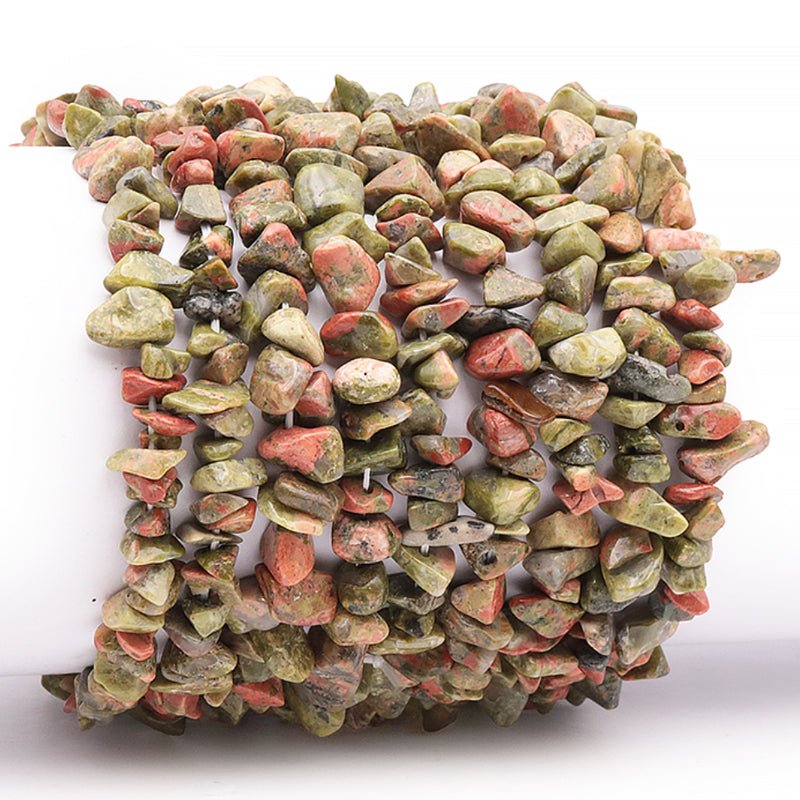
Beautiful A-grade South African unakite bracelet, made of polished baroque beads with characteristic colors blending green, salmon pink, orange pink, and sometimes beige.
The natural combination of green epidote and pink feldspar gives unakite its immediately recognizable appearance. Each stone has its own patterns and color proportions, making each bracelet a unique piece.
This A-grade South African unakite bracelet – good quality is made of polished natural stones in baroque shape.
Unakite is not a single mineral but a rock composed mainly of pink feldspar, green epidote, and quartz. It is the combination of these different minerals that gives it its speckled appearance and its very particular colors.
Its tones can vary from olive green to a deeper green, associated with salmon pink, orange pink, or beige areas. The proportion of each color naturally varies from one stone to another.
Baroque beads particularly highlight this diversity. Their irregular shapes enhance the natural and authentic appearance of the bracelet.
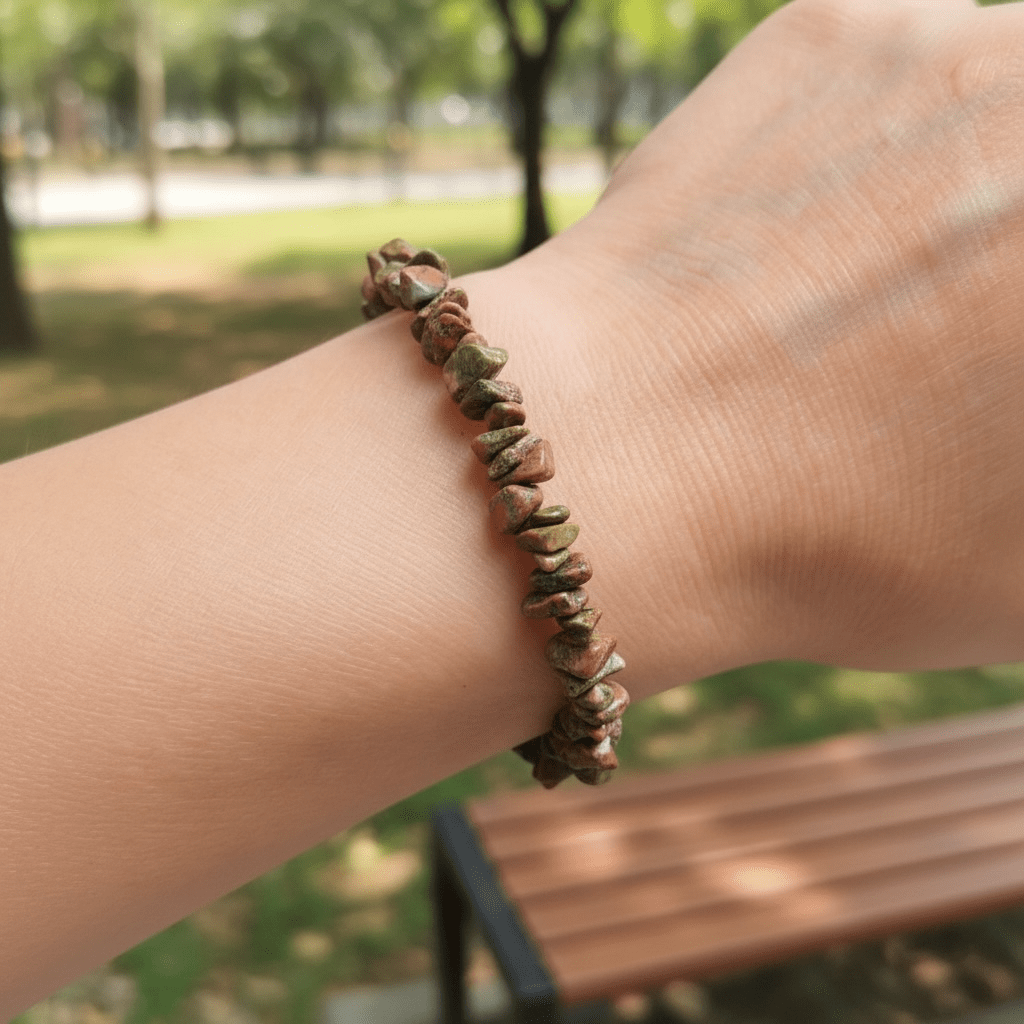
With a length of approximately 17 to 18 cm (6.7 to 7.1 inches), this elastic bracelet is suitable for wrists measuring approximately 16 to 18 cm (6.3 to 7.1 inches). Its weight of approximately 10 g (0.35 oz) allows it to be worn comfortably daily.
The shapes, patterns, and proportions of green, pink, and beige can vary from one stone to another and from one bracelet to another. Each item is unique.
Stone: Unakite
Nature: Rock composed of several minerals
Main composition: Epidote, feldspar, and quartz
Origin: South Africa
Grade: A – Good quality
Shape: Polished baroque beads
Dimensions: Approximately 17 to 18 cm (6.7 to 7.1 inches)
Recommended wrist size: 16 to 18 cm (6.3 to 7.1 inches)
Weight: Approximately 10 g (0.35 oz)
Mounting: Elastic bracelet
Colors: Green, salmon pink, orange pink, beige
Special feature: Naturally variable patterns created by the association of several minerals
In lithotherapy, unakite is traditionally associated with emotional balance, appeasement, and letting go.
It is particularly appreciated for symbolically accompanying people wishing to gain more perspective on their emotions and move forward more serenely.
Unakite is also associated with the ability to leave the past behind. It symbolizes renewal and accompanies periods of transition or personal change.
It is traditionally used to promote patience, gentleness, and understanding, both towards oneself and in relationships with others.
Its green and pink tones give it a strong symbolism related to feelings, love, and emotional harmony.
In lithotherapy, unakite is mainly associated with the heart chakra, traditionally linked to emotions, love, compassion, and emotional relationships.
The properties attributed to stones come from lithotherapy traditions and beliefs. They do not replace a diagnosis, treatment, or medical advice.
Unakite is a rock, not a unique mineral species.
It is mainly composed of an assemblage of:
The combination of these different minerals creates its easily recognizable speckled appearance.
The proportion of each constituent naturally varies, which explains why two unakites can have very different appearances.
The two characteristic colors of unakite mainly correspond to different minerals present in the rock.
The green primarily comes from epidote, while the pink parts are mainly composed of potassium feldspar.
Quartz may also be visible as lighter, grayish, or translucent areas.
This natural mixture produces the irregular patterns that make each stone unique.
The name unakite comes from the Unaka Mountains, located in the southeastern United States.
It was in this region that this rock was described in the 19th century.
Its name therefore refers to its historical identification location and not to its mineralogical composition.
Since then, similar materials have been discovered in different regions of the world.
No.
Even if its name comes from the Unaka Mountains in the United States, unakite or rocks of similar composition are now known in several regions of the world.
Your bracelet is thus offered with a South African origin, in accordance with the provenance indicated by your supplier.
One should therefore not confuse the historical origin of the stone's name with the provenance of a particular specimen.
Unakite is generally considered a rock resulting from the hydrothermal alteration of granitic rocks.
During this geological process, some granite minerals are modified and epidote develops.
The rock then retains quartz and feldspar, while the appearance of epidote produces the characteristic green areas.
It is this transformation that gives rise to the particular association of pink and green typical of unakite.
Unakite is sometimes marketed under the name "unakite jasper".
This appellation is common in the stone trade, but it is not strictly accurate from a mineralogical point of view.
Jasper is primarily a microcrystalline siliceous material belonging to the quartz family.
Unakite, on the other hand, is a rock notably composed of epidote, feldspar, and quartz.
For an accurate product sheet, the simple appellation "unakite" is therefore preferable.
Epidote is one of the main constituents of unakite, but the two terms are not synonymous.
Epidote is a mineral, usually green.
Unakite is a rock made up of several minerals, among which is epidote.
The green parts visible in unakite are therefore mainly linked to the presence of epidote.
Unakite can sometimes resemble certain green zoisites associated with other minerals, particularly due to its colors.
However, these are different materials.
Zoisite is a specific mineral species, while unakite is a rock mainly composed of epidote, feldspar, and quartz.
The famous ruby in zoisite, for example, generally combines green and red, but its composition and appearance are different from those of unakite.
Ruby in zoisite can sometimes be confused with unakite due to the association of green and pinkish to reddish colors.
However, ruby in zoisite contains real ruby crystals, often red to dark pink, embedded in a predominantly green matrix.
In unakite, the pink areas mainly correspond to feldspar and not to ruby.
This difference allows for easy distinction between the two materials when their characteristics are clearly visible.
Unakite has several interesting characteristics for jewelry making.
Its naturally contrasting green and pink colors are original and easily recognizable.
It also takes a beautiful polish that reveals the different minerals present in the rock.
Each piece having a different pattern, it is particularly well suited for making baroque beads, tumbled stones, cabochons, and pendants.
This bracelet is offered in grade A – good quality.
The stones have a beautiful overall appearance while retaining their natural color and pattern differences.
Some beads may have more green, while others will be dominated by salmon pink or orange pink.
The amount of visible quartz can also vary.
Commercial classifications A, A+, AA, or AAA do not correspond to a standardized international gemological scale. They mainly serve to differentiate different selection levels offered by a supplier or seller.
Baroque beads have irregular shapes, unlike perfectly round and calibrated beads.
This finish is particularly suitable for unakite because it highlights the natural variations between the different minerals.
Each stone has its own combination of green, pink, beige, and lighter areas.
The color distribution, patterns, and shapes may therefore vary significantly from one bracelet to another. The received bracelet may naturally differ from the photographs presented.
Unakite is well suited for jewelry use, but a few precautions can help preserve its polish over time.
Avoid heavy impacts as well as contact with chemicals, perfumes, and household products.
For routine cleaning, simply use a soft, slightly damp cloth, then carefully dry the stones.
To also preserve the elastic thread, it is preferable to remove your bracelet before showering, swimming, cleaning, or sports activities.
This jewel highlights the unique reflections of unakite. Discover all our unakite bracelets to complete your collection.
Color :
Astrological sign:
Stone Type:
Age :
Gender :


Les vertus décrites relèvent de la tradition de la lithothérapie et ne constituent ni un avis médical ni un conseil de santé. En cas de problème de santé, consultez un professionnel.