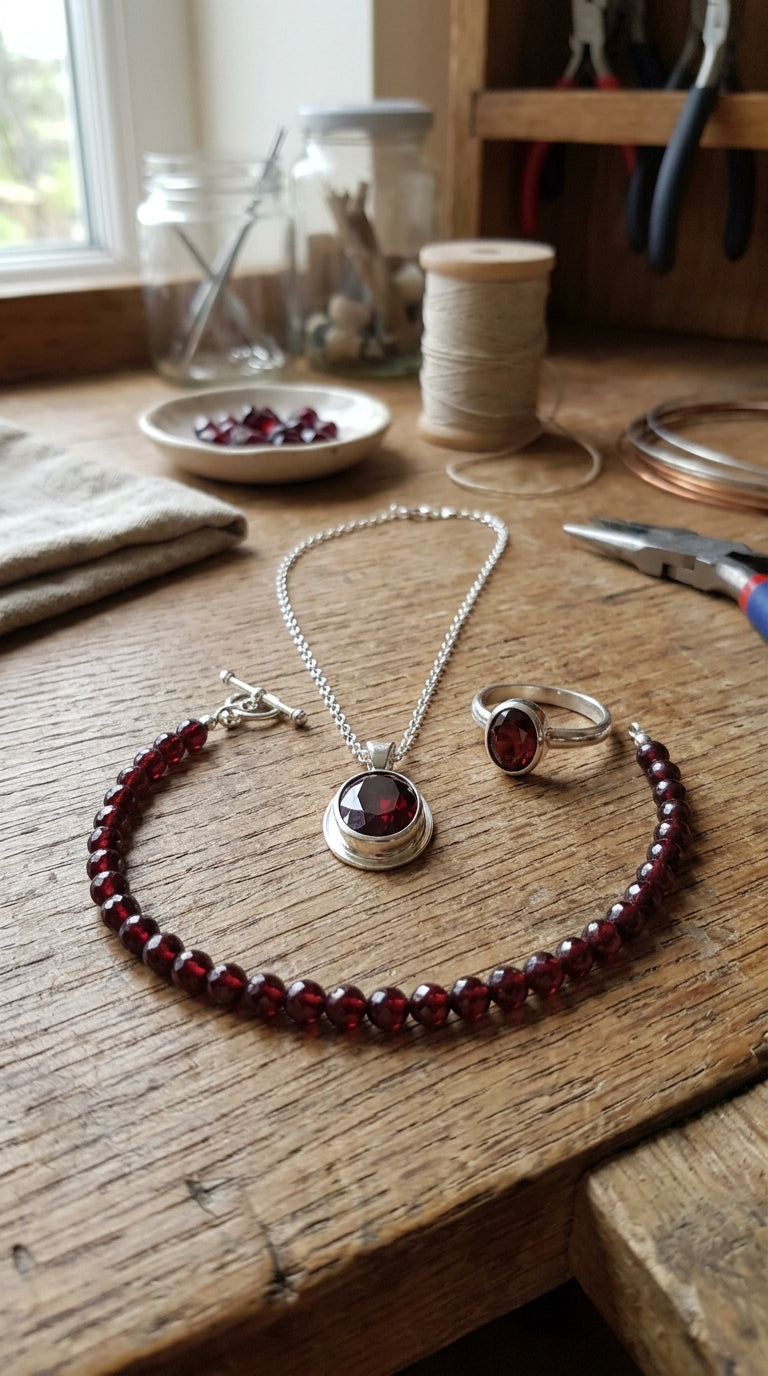
Garnet jewelry carries within it a contained fiery energy. This dark, deep red, sometimes so intense that it leans towards burgundy or black under certain lights, has a presence that leaves no one indifferent. Garnet gets its name from the Latin *granatum* (pomegranate), and when one sees raw garnet crystals, the resemblance to the fruit's seeds is striking. It is actually a family of minerals that includes several varieties: almandine (dark red, the most common), pyrope (blood red), rhodolite (raspberry pink), grossular (green, orange), and many others. Vikings used it as a navigation stone, Crusaders wore it as a protective talisman, and Bohemian jewelers made it a specialty in the 18th century.
In lithotherapy, garnet is a stone of vital energy, passion, and deep grounding. It works on the root chakra (1st chakra) and rekindles the life force when it fades. It is a stone recommended during periods of exhaustion, convalescence, or loss of motivation. Garnet is traditionally believed to stimulate blood circulation, strengthen physical vitality, and awaken passion, whether in romantic life or personal projects. It is a stone of regeneration, not gentleness: it pushes, it warms, it restarts movement.
Garnet pairs well with ruby (intensified passion), carnelian (creativity and joy of living), or smoky quartz (grounding and letting go). For a balance between fire and calm, the garnet and amethyst duo works very well. For care, a rinse with clear water and recharging in the sun or on a quartz cluster are sufficient. With a hardness of 6.5 to 7.5 on the Mohs scale depending on the variety, garnet is a solid stone that withstands daily wear well.