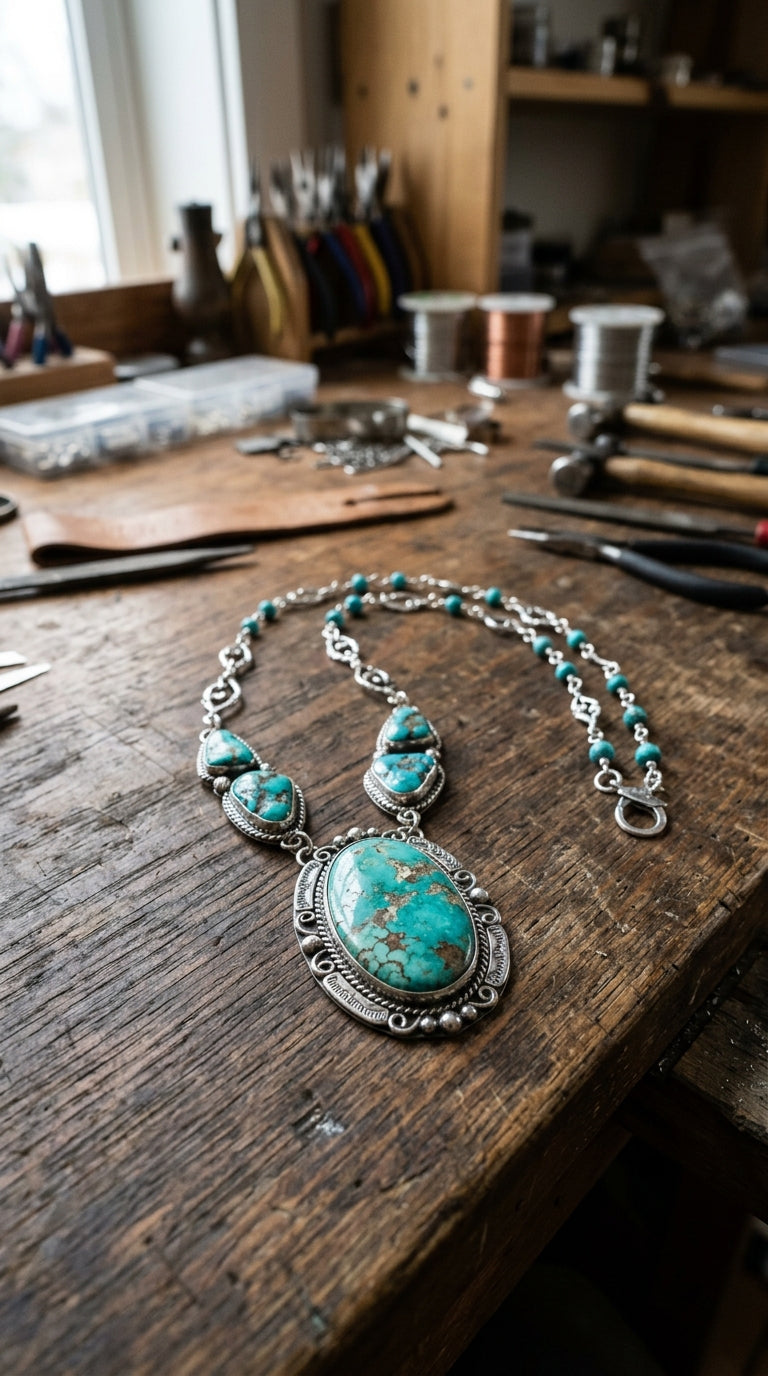
The turquoise necklace is one of humanity's oldest pieces of jewelry. From adornments found in Egyptian tombs dating back to 4000 BC to the massive necklaces of Navajo chiefs, this blue-green stone has graced the necks of men and women across cultures and eras. And wearing a turquoise necklace today is to join this millennia-old tradition. Worn around the neck, turquoise is naturally located at the throat chakra, exactly where it works best. Its unique blue-green color, streaked with brown or black veins (the matrix), gives each pendant or bead an absolutely irreplaceable pattern. The blue comes from copper, the dark veins from the host rock in which the turquoise formed.
In lithotherapy, the turquoise necklace is renowned for its protective, communicative, and healing properties. Worn around the neck, it helps one express themselves authentically, set healthy boundaries, and communicate with kindness. It is also the traveler's stone par excellence: Native Americans never set out without it, and this tradition continues for many people today. Turquoise pairs very well with lapis lazuli (wisdom and truth), carnelian (vitality and creativity), or rock crystal (amplification). For care, turquoise is porous and requires special attention. No chemical products, no perfume, no prolonged water exposure. Clean your necklace with a dry soft cloth and recharge it under moonlight. With a hardness of 5 to 6 on the Mohs scale, remove it before showering and sports.




 Arizona turquoise pendant A rolled stone 925 silver buckle


 Spiny Oyster Arizona Turquoise Pendant (Kingman) AAA 925 Silver